
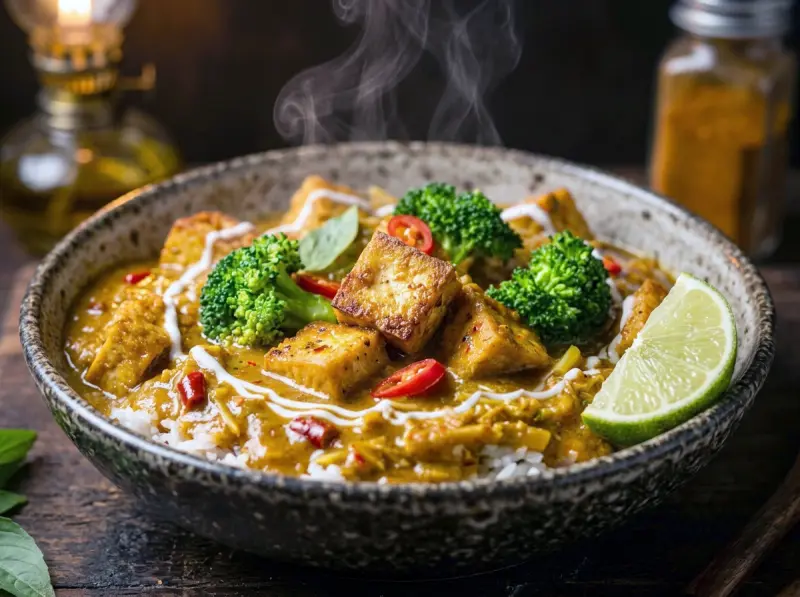
Curry de Coco Vegan
Du tofu aux bords croustillants et des légumes mijotés dans une sauce parfumée de lait de coco et pâte de curry, terminé avec du jus de citron vert et des herbes fraîches. Le type de plat qui fait sentir la cuisine de façon extraordinaire et qui semble avoir pris beaucoup plus de temps qu'il n'en a fallu.
Ingrédients
- 400 gtofu extra-ferme, pressé 20+ min
- 2 c. à soupepâte de curry rouge ou jaune thaïlandaise
- 400 mllait de coco entier en boîte
- 200 mlbouillon de légumes
- 1 grand oignon
- 3 ail
- 1 c. à soupegingembre frais
- 1 poivron rouge
- 200 gfleurettes de brocoli ou de chou-fleur
- 100 gjeunes épinards ou kale
- 2 c. à soupesauce soja ou tamari
- 1 c. à cafésucre de coco ou cassonade claire
- 1 citron vert
- 2 c. à soupehuile neutre
- 1 petit bouquetpetit bouquet de basilic thaï ou coriandre
Préparation
- Dorer le tofu. Chauffer 1 c. à soupe d'huile dans un grand wok à feu moyen-vif. Ajouter les dés de tofu en une seule couche sans surcharger. Cuire sans bouger 3-4 minutes jusqu'à ce qu'une croûte dorée se forme en dessous, retourner et répéter sur tous les côtés. Retirer sur une assiette.
- Faire frire la pâte de curry. Ajouter l'huile restante dans la même poêle à feu moyen. Ajouter la pâte de curry et faire frire en remuant constamment 60-90 secondes jusqu'à ce qu'elle s'assombrisse légèrement et embaume. Ajouter l'oignon et cuire 3 minutes. Ajouter l'ail et le gingembre et cuire encore 60 secondes.
- Construire la sauce. Ajouter le poivron rouge et les fleurettes de brocoli. Remuer pour enrober de pâte. Verser le bouillon et les deux tiers du lait de coco. Remuer et porter à un léger frémissement. Ajouter la sauce soja et le sucre. Mijoter 8-10 minutes.
- Ajouter le tofu et terminer. Remettre le tofu croustillant. Ajouter le lait de coco restant. Réduire à feu doux. Incorporer les épinards et laisser se flétrir 60 secondes. Presser le jus de citron vert et ajouter le zeste.
- Servir. Répartir sur du riz au jasmin et parsemer de basilic thaï ou de coriandre fraîche. Servir avec des quartiers de citron vert supplémentaires.
Questions
Les meilleurs : aubergine (absorbe la sauce), courge ou patate douce (douceur et structure), brocoli et chou-fleur (maintiennent leur forme), poivron rouge (douceur et couleur), petits pois et épinards (à la fin). Timing : denses (courge) au début, moyens (poivron, brocoli) au milieu, délicats (épinards, petits pois) dans les 2-3 dernières minutes. Éviter : concombre, salade, avocat.
Oui, bien que le résultat soit plus simple. Substitution de 2 c. à soupe de pâte rouge : 1 c. à café chacun de coriandre et cumin, ½ c. à café de piment en poudre, 1 c. à café de curcuma, 1 c. à soupe de concentré de tomate plus ail et gingembre frais. Pour le profil thaïlandais, la pâte de curry est irremplaçable.
Toujours mieux entier — il donne l'épaisseur et la crémosité nécessaires. Le lait de coco en brique est trop liquide. Substituts acceptables : crème de coco en boîte, crème de cajou, crème végétale entière 20%+. Ajouter deux tiers lors de la cuisson et le tiers restant à la fin à feu doux.
Se conserve 4-5 jours au réfrigérateur et 3 mois congelé. La séparation au refroidissement est normale. Pour réchauffer : feu doux en remuant — la sauce se réémulsionnera. Ne pas faire bouillir fort. Pour congeler : sans riz, dans des contenants hermétiques.
Dépend de la pâte. Verte est la plus piquante, jaune la plus douce. Pour les enfants commencer avec 1 c. à soupe de pâte jaune ou rouge. Le lait de coco tempère considérablement. Meilleur moment pour goûter : après la friture de la pâte avant d'ajouter le coco. Servir de la sauce piquante à part à table.
Notez
Des recettes par e-mail
Une lettre par semaine : une recette choisie selon vos goûts et les nouveautés du site. Vous pouvez la désactiver en un clic.
En cadeau : le livre de recettes de Sergei (e-book).
En cliquant sur le bouton, vous acceptez la politique de confidentialité.
Dites-nous ce que vous aimez cuisiner (30 secondes) →Continuez à parcourir
D’autres plats des archives — choisis pour leur proximité avec ce que vous êtes en train de cuisiner.
Rejoignez la discussion
Commentaires (1)
I learned to make this curry from a street vendor in Chiang Mai who let me watch her cook for an entire afternoon. The secret she showed me: fry the curry paste in the thick cream that rises to the top of the coconut milk can, not in oil. The coconut fat carries the spice compounds differently and the flavour is rounder. And always add the lime juice at the very end, off the heat — cooking it kills the brightness.