
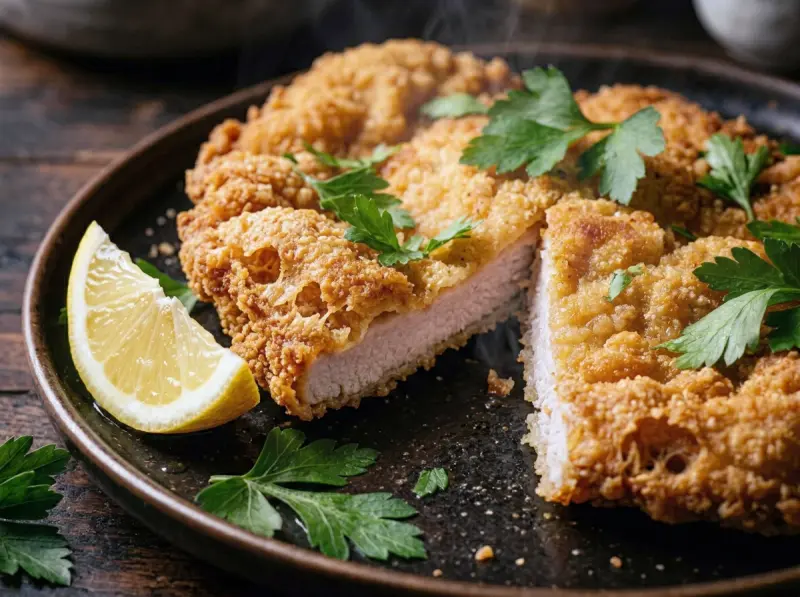
Schnitzel (Escalope Allemande Panée)
Des fines escalopes de porc ou de veau aplaties à 3-4 mm, panées avec de la farine, de l'œuf et de la chapelure, puis frites dans de la graisse chaude jusqu'à ce que la croûte soit dorée et croustillante. La marque d'un bon schnitzel est une croûte légèrement gonflée et décollée de la viande avec des poches d'air. Servir immédiatement avec un quartier de citron.
Ingrédients
- 4 côtelettes de longe de porc désossées, ~150 g chacune
- 1 c. à cafésel fin
- 0.5 c. à cafépoivre blanc
- 80 gfarine
- 2 œufs
- 1 c. à soupelait entier
- 120 gchapelure fine non assaisonnée
- 200 mlhuile neutre pour friture
- 2 c. à soupebeurre doux
- 1 citron coupé en quartiers
Préparation
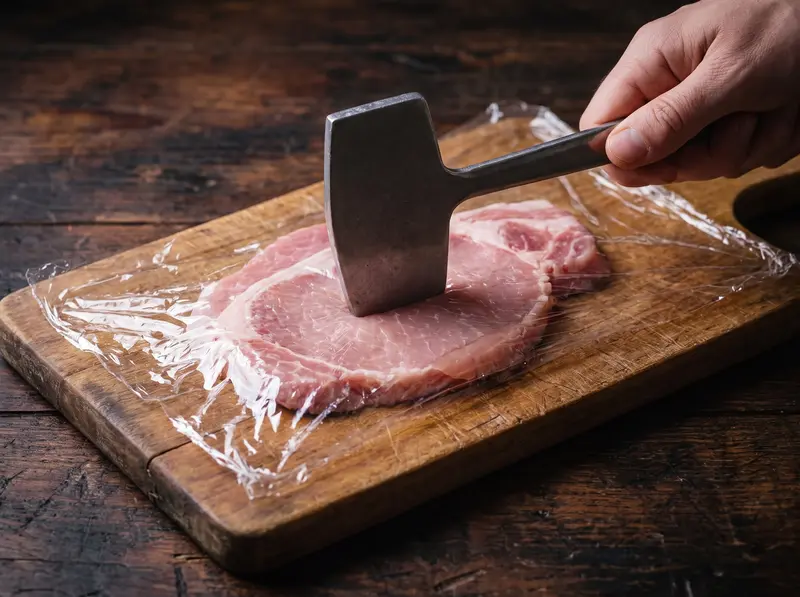
- Aplatir les côtelettes. Placer chacune entre deux feuilles de film étirable ou dans un sac zip. Avec le côté plat d'un attendrisseur ou le fond d'une lourde poêle, aplatir du centre vers les bords jusqu'à une épaisseur uniforme de 3-4 mm. Assaisonner les deux côtés.
- Préparer la station de panure. Farine dans une assiette, les œufs battus avec le lait dans une autre, la chapelure dans une troisième. Passer la côtelette : farine sur toutes les surfaces, œuf, chapelure. Ne pas appuyer la chapelure contre la viande — poser, soulever et secouer doucement les miettes lâches.
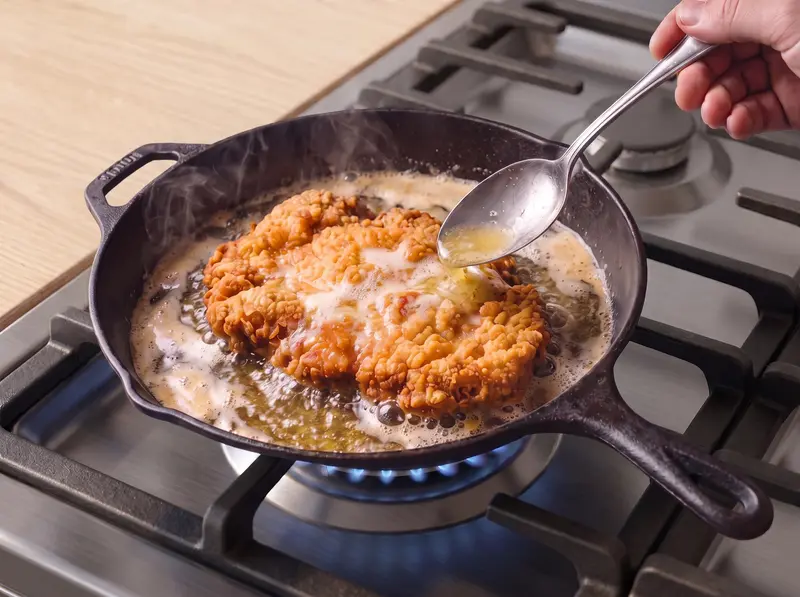
- Frire immédiatement. Chauffer l'huile dans une grande poêle lourde à feu moyen-vif. Quand l'huile est chaude, ajouter le beurre. Quand la mousse se dissipe, ajouter 1-2 schnitzels. Incliner et faire tournoyer la poêle pour que la graisse chaude baigne continuellement la surface. Frire 2-3 min par côté jusqu'à dorure profonde.
- Égoutter et servir immédiatement. Retirer avec des pinces et poser brièvement sur une grille. Ne pas couvrir ni empiler. Servir sur des assiettes chaudes avec des quartiers de citron.
Questions
Wiener Schnitzel est un terme protégé légalement : seulement avec du veau. Le schnitzel allemand (Schweineschnitzel) est avec du porc. La technique est identique. Le porc en style viennois s'appelle Schnitzel Wiener Art dans les menus allemands.
Appuyer compacte la chapelure en couche dense. En friture elle dore mais ne se soulève pas. La croûte gonflée caractéristique se forme seulement quand la chapelure est meuble — la vapeur pousse la couche non compressée loin de la surface.
Trois conditions : les miettes ne sont pas pressées ; assez de graisse pour flotter ; incliner et tourbillonner la poêle constamment. Sans l'une de ces trois, la croûte sera plate.
La tradition pour Wiener Schnitzel est le beurre clarifié (Butterschmalz). Le beurre normal brûle. Solution pratique : huile neutre + 1-2 c. à soupe de beurre normal ajouté juste avant.
Jäger = chasseur. Jägerschnitzel = schnitzel avec sauce crémeuse aux champignons. Faire revenir champignons avec oignon, ajouter vin blanc et réduire, ajouter crème et thym, mijoter 5 min.
Notez
Des recettes par e-mail
Une lettre par semaine : une recette choisie selon vos goûts et les nouveautés du site. Vous pouvez la désactiver en un clic.
En cadeau : le livre de recettes de Sergei (e-book).
En cliquant sur le bouton, vous acceptez la politique de confidentialité.
Dites-nous ce que vous aimez cuisiner (30 secondes) →Continuez à parcourir
D’autres plats des archives — choisis pour leur proximité avec ce que vous êtes en train de cuisiner.
Rejoignez la discussion
Commentaires (5)
Das Fleisch muss dünn geklopft werden, sonst wirds nix. Und die Panade: Mehl, Ei, Semmelbrösel — keine Abkürzungen! Hab auch schon versucht mit Cornflakes, schmeckt komisch
Genau so macht mans richtig. Paniermehl muss frisch sein, nicht aus der Packung. Hab extra Semmelbrösel selbst gemacht und der Unterschied ist enorm.
Sehr gut, fast wie bei meiner Oma in Wien. Einziger Tipp: das Fleisch muss wirklich dünn sein, sonst wird's nix. Ich hab es heute mit Kartoffelsalat serviert und die Kinder waren begeistert.
I learned to make schnitzel from an Austrian grandmother who insisted on three things: pound the meat until it is uniformly thin (about 5mm), use your hand to press the breadcrumbs on firmly before frying, and use enough fat that the schnitzel floats. If the bottom of the pan is visible through the oil, you do not have enough. The breadcrumb coating should puff away from the meat slightly — that air pocket is the mark of a properly fried schnitzel.
Шницель получился отличный с первого раза. Единственое что я отбивал мясо молотком через пищевую плёнку — так не рвётся и толщина равномерная. Панировку делаю тройную: мука, яйцо, сухари. И жарю именно в смеси масла и сливочного, как тут написано. Хрустит идеально.