Skip to content
GetCookMatch
Eggs Royale (Smoked Salmon Benedict) with eggs, smoked salmon and English muffins — UK recipeUKUK
📝Useful tips
S
Sergei Martynov

The most common hollandaise failures are temperature problems. If the yolks overheat during the double boiler method, they scramble into curds — the sauce is then unusable and you have to start again. If the butter is too cold when added, it doesn't emulsify. The blender method avoids both problems by using the mechanical action of the blender rather than heat to create the emulsion, and the hot butter provides just enough gentle heat to cook the yolks safely without scrambling them. If your hollandaise splits at any point, the quickest fix is: add a teaspoon of cold water and whisk vigorously. If it still won't come together, start with a fresh yolk in a clean bowl, whisk it until pale, then slowly add the split sauce as if it were the butter.

💡

For a crowd: poach all the eggs in advance, transfer to iced water, and refrigerate for up to 24 hours. When ready to serve, bring a pan of water to a simmer and slide the cold eggs in for exactly 60 seconds. They emerge warm with the yolk still runny. This technique is used in restaurant kitchens to serve twenty perfectly poached eggs simultaneously and it works just as well at home for Sunday brunch for six.

Breakfast and Brunch

Eggs Royale (Smoked Salmon Benedict)

By Sergei Martynov

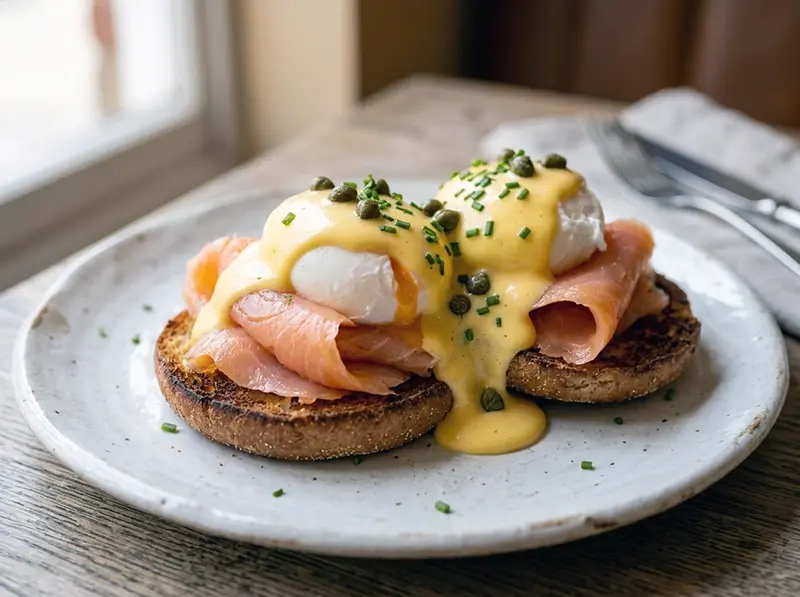
Toasted English muffins with cold smoked salmon, perfectly poached eggs, and hollandaise. Eggs Royale is Eggs Benedict with smoked salmon in place of Canadian bacon — same structure, slightly more refined flavour, and arguably easier to time because the salmon needs no cooking. The difficulty is coordinating three things that need to be ready simultaneously: the poached eggs, the warm hollandaise, and the toasted muffins. The order and timing matter. Read through the whole recipe before you start.

⏱️
20
Minutes
👥
2
Servings
🔥
560
kcal
Rate this recipe

Key Ingredients

What you'll need

Ingredients

How to make it

Instructions

  1. 1

    Make the hollandaise first and keep it warm. Melt the butter in a small saucepan — it should be hot and fully melted but not browned. In a heatproof bowl or blender, combine the 3 egg yolks, lemon juice, Dijon, and cayenne. For the blender method: blend the yolk mixture for 30 seconds, then with the motor running, pour in the hot butter in a slow, steady stream — the sauce will emulsify and thicken in about 30 seconds total. For the double boiler method: set the bowl over a pan of barely simmering water (not touching), whisk the yolks until pale and slightly thickened, then remove from heat and slowly whisk in the hot butter, a little at a time. Season with salt. Keep the hollandaise warm by resting the bowl over warm (not hot) water, or transfer to a thermos. If it thickens too much, stir in a teaspoon of warm water.

  2. 2

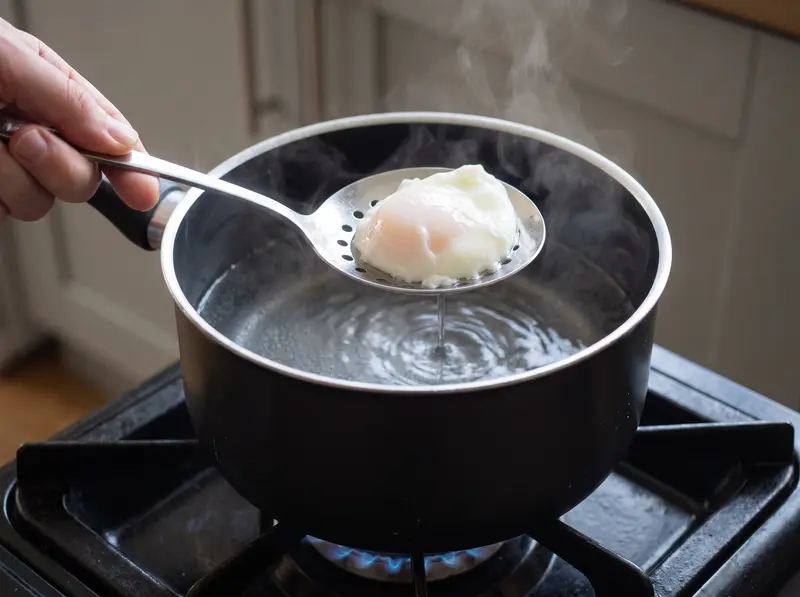
    Poach the eggs. Fill a wide, deep saucepan with about 7 cm of water and add the white wine vinegar. Bring to a gentle simmer — you want small bubbles rising from the bottom, not a rolling boil. Crack each egg into a small cup or ramekin first (never directly into the water). Lower the cup close to the water surface and tip the egg in gently. Add the eggs one at a time, 30 seconds apart. Poach for 3 minutes for a runny yolk, 3.5 minutes for slightly firmer. Do not boil vigorously — the turbulence tears the whites apart. Lift each egg with a slotted spoon and touch the white gently: it should be completely set and firm. The yolk should still move if you press it.

  3. 3

    Drain and trim the eggs. Remove each egg with a slotted spoon and rest briefly on a clean folded tea towel or a plate lined with kitchen paper to absorb excess water. This prevents the egg water from diluting the hollandaise. If any ragged strands of white have formed, trim them with scissors for a cleaner presentation. For advance preparation: cook the eggs, immediately transfer to a bowl of iced water to stop the cooking, and refrigerate for up to 24 hours. To serve, slide into barely simmering water for 60 seconds to reheat.

  4. 4

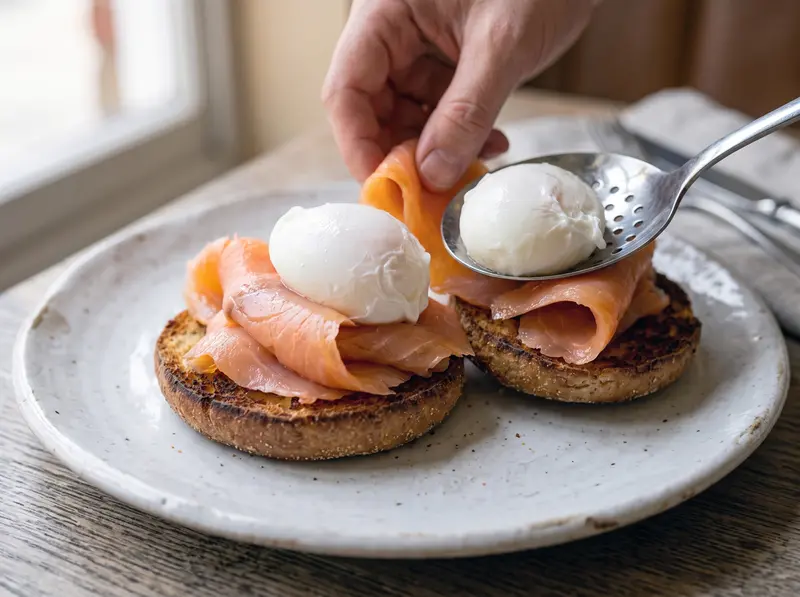
    Toast the muffins and assemble. Toast the English muffins until golden — they need structure to support the topping, so they should be properly toasted, not just warm. Lay the smoked salmon generously over each muffin half. Salmon should cover the muffin completely and drape slightly over the edges. Place the drained poached egg directly on top of the salmon. The warmth of the egg will very slightly warm the salmon, which is desirable — cold salmon under a hot egg is better than trying to warm it separately.

  5. 5

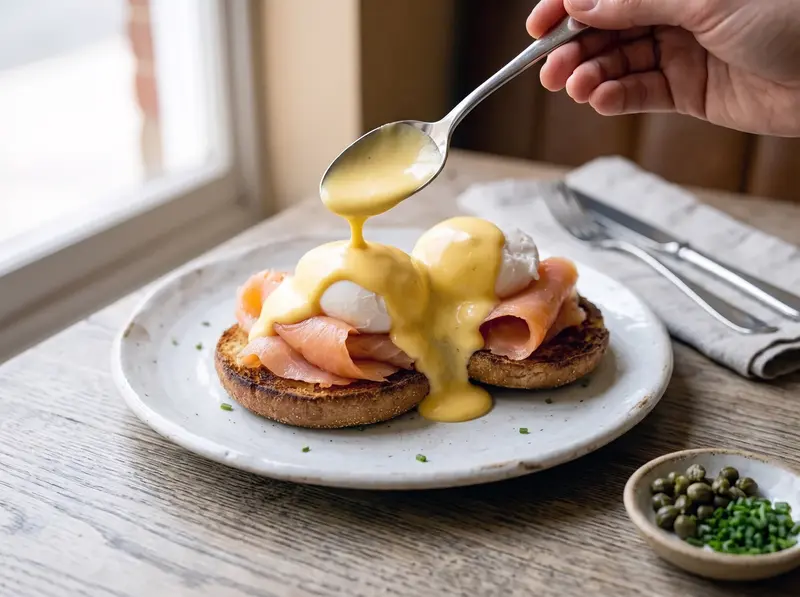
    Spoon hollandaise over and serve immediately. Spoon the warm hollandaise generously over each egg — it should pool on the egg and run slightly over the salmon and muffin edge. Scatter chives and capers if using. Serve immediately on warmed plates: hollandaise cools and thickens within minutes. This is not a dish that waits. If cooking for more than two, stagger the assembly so each plate is finished in sequence rather than all at once.

Join the conversation

Comments

Leave a comment

Loading comments…

Frequently Asked Questions

What is the difference between Eggs Royale, Eggs Benedict, and Eggs Florentine?

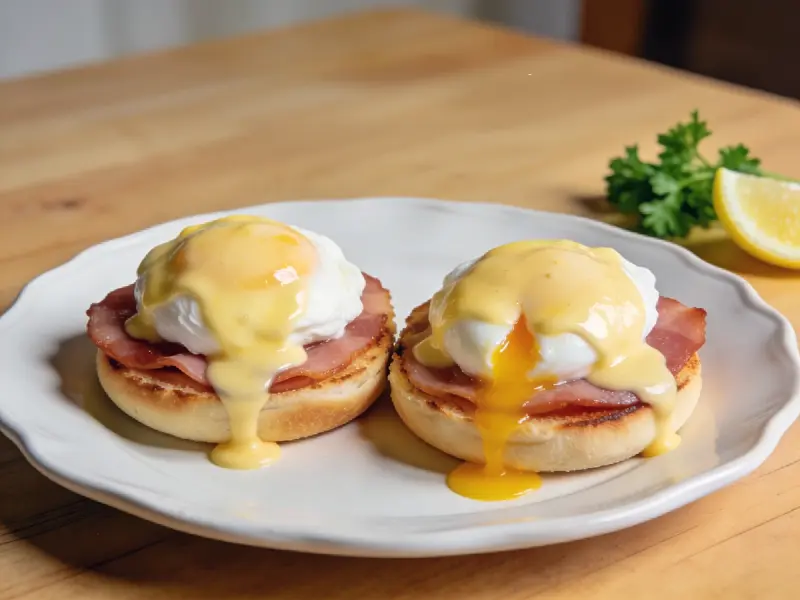
They share the same structure: toasted English muffin, poached egg, and hollandaise. The only difference is what goes between the muffin and the egg. Eggs Benedict uses Canadian bacon (back bacon) or sliced ham. Eggs Royale uses cold smoked salmon. Eggs Florentine uses wilted spinach — making it the vegetarian version. Some restaurants also serve Eggs Hemingway (with avocado) and Eggs Atlantic (another name for Royale). The technique and hollandaise are identical across all versions.

How do you poach eggs without them spreading all over the water?

Fresh eggs hold their shape significantly better than older eggs — the white of a fresh egg is thick and cohesive, while an older egg has a thin, runny white that spreads. Beyond freshness: crack into a small cup first and slide in gently rather than dropping; keep the water at a gentle simmer rather than a boil (turbulence tears the white apart); add a splash of white wine vinegar (it sets the white faster); and lower the cup to just above the water surface before tipping. The egg should sink, then float back up as it cooks.

How do you fix hollandaise that has split (broken)?

A split hollandaise looks grainy or watery rather than smooth and creamy. The quick fix: add a teaspoon of cold water and whisk vigorously — this sometimes brings it back. If not: put a new egg yolk in a clean bowl, whisk it until slightly pale, then slowly add the split sauce into the yolk as if it were butter, whisking constantly. The fresh yolk re-emulsifies the sauce. Prevention is easier: keep the heat very low during the double boiler method, and add the butter slowly — too fast and the emulsion breaks.

What type of smoked salmon is best for Eggs Royale?

Cold smoked salmon is traditional and best — it's silky, thin-sliced, with a subtle smoke that doesn't overwhelm the egg and hollandaise. Hot smoked salmon (which is firmer and flakier) is a valid alternative and gives a different texture. Gravlax (cured with salt, sugar, and dill rather than smoked) is excellent for a lighter, more Nordic version. Wild salmon tends to have a cleaner flavour than farmed. Whatever type you use, bring it to room temperature for 15 minutes before serving — cold salmon directly from the fridge under a hot egg creates an unpleasant temperature contrast.

Can hollandaise be made ahead?

Hollandaise is best made and served within 30 minutes. It can be held warm over a hot water bath for up to 30 minutes without significant quality loss, but it gradually thickens and can break if the water gets too hot. Do not refrigerate and reheat — the sauce separates on cooling and the reheating process almost always breaks it. If you need to make it slightly ahead, keep it in a wide-mouthed thermos that you've prewarmed with boiling water — it will stay warm and pourable for 20 to 30 minutes. Thin with a teaspoon of warm water before serving if needed.