The grill step at the end — switching to maximum broiler heat after the roast — is not optional if you want a gyros that resembles the real thing. The outside of the stack needs to become genuinely crispy and charred, not just browned. That crust, sliced off in thin strips, is what gives gyros its distinctive combination of crispy edges and soft interior in the same bite. Without the grill finish, what you have is tasty roast pork — good, but not gyros.
The tzatziki improves significantly with resting time. Make it the day before if possible — the garlic mellows, the dill infuses, and the texture thickens. The one non-negotiable step for tzatziki is squeezing the cucumber completely dry before mixing. Any water from the cucumber will make the tzatziki runny within an hour. For a crisper pita: press the filled wrap flat on a hot dry pan for 30 seconds per side — the outside gets crisp while the inside stays warm.
Gyro
By Sergei Martynov
Thin-sliced seasoned pork roasted until the edges turn crisp and golden, served in warm pita with tzatziki, tomato, and onion. The restaurant gyros is cooked on a vertical rotisserie — meat stacked in layers, spinning slowly, the outer crust shaved off in strips as it crisps. At home, the closest result comes from threading marinated pork pieces onto a vertical skewer propped over an onion half in a roasting pan, then finishing under the grill. The marinade is oregano, paprika, cumin, garlic, vinegar, and olive oil. The tzatziki is made from scratch and is not optional.
What you'll need
Ingredients
- 800 g
See recipes with pork shoulder steakspork shoulder steaks, about 1 cm thick — fatty cuts stay juicy
i - 200 g
See recipes with pork belly slices — adds fat and flavour; substitute: extra shoulderpork belly slices — adds fat and flavour; substitute: extra shoulder
i - 4 tbsp
See recipes with olive oilolive oil
i - 3 tbsp
See recipes with white wine vinegarwhite wine vinegar
i - 1.5 tsp
See recipes with dried greek oreganodried Greek oregano
i - 1 tsp
See recipes with sweet paprikasweet paprika
i - 1 tsp
See recipes with ground cuminground cumin
i - 3
See recipes with garlic clovesgarlic cloves, grated
i - 1 tsp
See recipes with fine saltfine salt
i - 0.5 tsp
See recipes with black pepperblack pepper
i - 300 g
See recipes with greek yogurt — for tzatzikiGreek yogurt (full-fat) — for tzatziki
i - 1
See recipes with cucumbercucumber, grated and squeezed dry — for tzatziki
i - 2
See recipes with garlic clovesgarlic cloves, very finely minced — for tzatziki
i - 2 tbsp
See recipes with fresh dill or mintfresh dill or mint, chopped — for tzatziki
i - 4
See recipes with pita breadspita breads, warmed
i - 2
See recipes with ripe tomatoesripe tomatoes, sliced
i - 1
See recipes with red onionred onion, thinly sliced
i
How to make it
Instructions
- 1
Marinate the pork. Combine olive oil, vinegar, oregano, paprika, cumin, garlic, salt, and pepper in a bowl. Add the pork shoulder steaks and belly slices. Coat thoroughly and refrigerate for a minimum of 4 hours, preferably overnight. The vinegar tenderises the meat and helps it crisp at the edges during roasting.
- 2
Make the tzatziki. Grate the cucumber on the coarse side of a box grater. Place in a clean cloth and wring out all moisture — it should feel nearly dry. Combine the drained cucumber with the Greek yogurt, minced garlic, dill or mint, and a pinch of salt. Stir well, taste, adjust. Refrigerate for at least 30 minutes before serving — the flavour deepens as it sits.
- 3
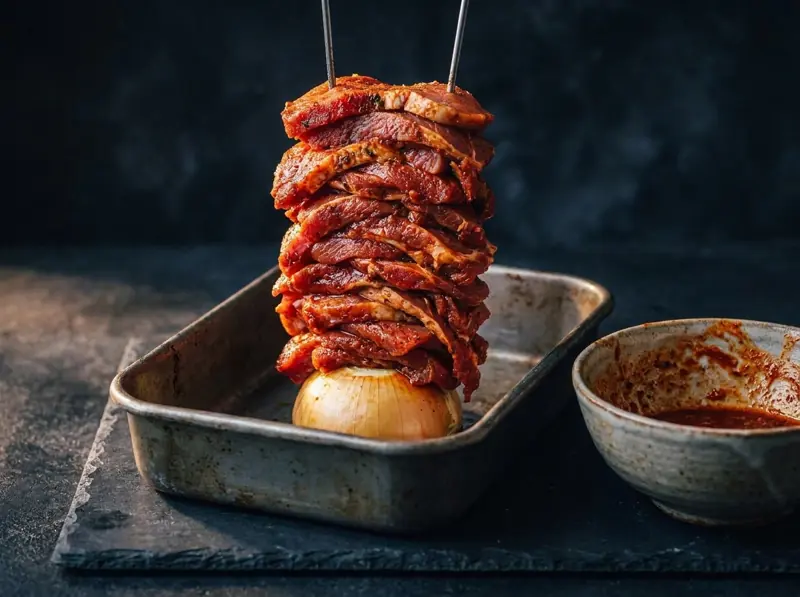
Build the vertical spit (home method). Cut an onion in half and place flat-side down in a small roasting tin or deep oven-safe dish. Push two long metal skewers or wooden skewers (pre-soaked) through the onion halves to create a vertical support. Thread the marinated pork pieces onto the skewers alternately — shoulder, belly, shoulder — pressing each layer snugly down. The stack should be 15 to 20 cm tall. Pour any remaining marinade over the top.
- 4
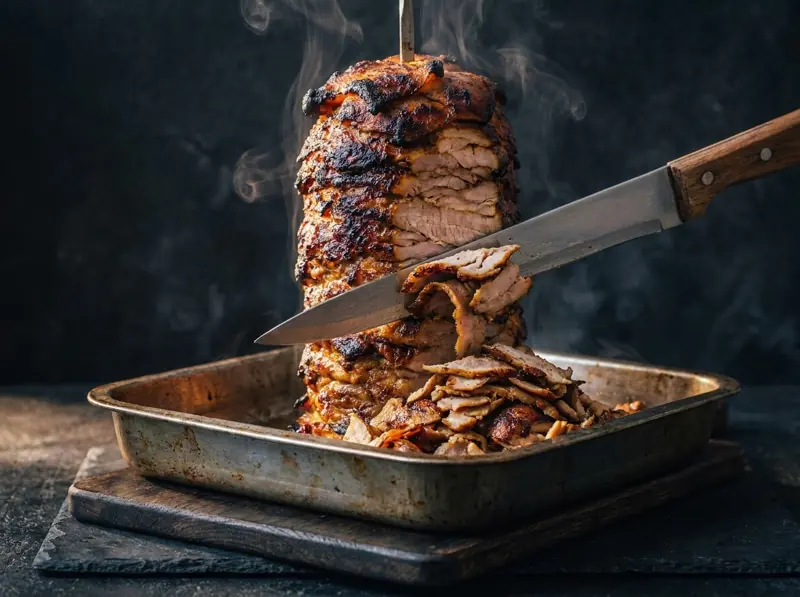
Roast and grill. Preheat the oven to 200°C. Roast the pork stack for 50 to 60 minutes until cooked through and beginning to colour on the outside. The internal temperature of the thickest piece should reach 70°C. Switch the oven to grill/broil at maximum heat and grill for 8 to 10 minutes until the outer layer is genuinely crispy and charred at the edges. This grill step is what replicates the rotisserie crust. Rest for 5 minutes, then carve thin strips off the outside of the stack with a sharp knife.
- 5
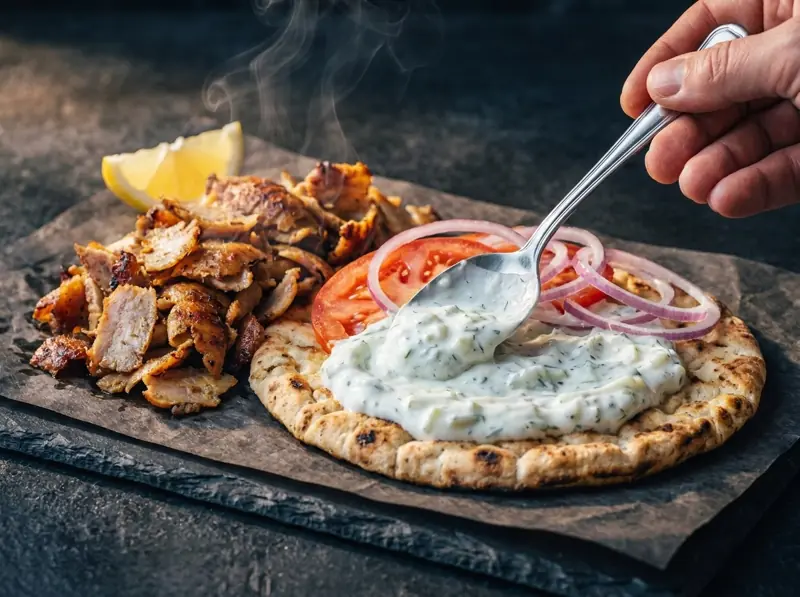
Assemble and serve. Warm the pita breads briefly on a hot dry pan or directly over a gas flame. Lay each pita flat, spread tzatziki generously, add a handful of sliced tomato and raw red onion, then pile the carved gyros meat on top. Fold the pita around the filling and serve immediately. The pita can also be wrapped in foil to hold its shape. Serve with extra tzatziki on the side.
Frequently Asked Questions
How do you make gyros at home without a vertical rotisserie — what is the oven method?
The closest home equivalent is a DIY vertical spit: push two long metal skewers vertically through an onion half placed in a roasting tin, creating a support structure. Thread the marinated pork slices onto the skewers in layers, pressing each one down tight. Roast at 200°C for 50 to 60 minutes, then switch to maximum grill/broil for 8 to 10 minutes to develop the outer crust. The onion base absorbs the drippings and you carve off thin strips from the outside once it comes out of the oven. The result is not identical to a rotating spit but achieves the same combination of crisp crust and juicy interior.
Which meat is best for gyros — pork, lamb-beef, or chicken?
In Greece, pork is the standard and the original — specifically pork shoulder and neck, sometimes mixed with fatty pork belly. The fat content is essential: lean pork dries out on the slow roast. In North America, the common restaurant version uses ground lamb and beef pressed into a cone shape — this is actually closer to Turkish döner kebab and is a Greek-American adaptation. Chicken gyros is now popular in Greece as a lighter option. For the most authentic Greek experience, pork shoulder is the answer. The combination of shoulder and belly — one cut for structure, one for fat and flavour — gives the most realistic result.
How do you make proper tzatziki for gyros?
Tzatziki has four components: Greek yogurt, cucumber, garlic, and herbs (dill or mint). The process is simple but one step is critical: the cucumber must be completely dried before mixing. Grate the cucumber on the coarse side of a box grater, place in a clean cloth, and wring out every drop of moisture. Any residual cucumber water will thin the tzatziki within an hour. Combine with full-fat Greek yogurt, very finely minced raw garlic, fresh dill or mint, a little olive oil, and salt. Let it rest for at least 30 minutes — preferably overnight — before serving. The flavour of the garlic rounds out significantly with time.
What is the difference between gyros, shawarma, and döner kebab?
All three descend from the same technique — meat stacked on a vertical spit, rotating beside a heat source, carved as the outer layer crisps. Döner kebab, originating in 19th-century Bursa, Turkey, is the original — usually lamb or beef, served with flatbread and vegetables. Shawarma developed across the Arab world, typically using lamb, beef, or chicken marinated with cumin, cardamom, turmeric, and cinnamon, served with hummus, pickles, and garlic sauce. Gyros arrived in Greece after the Ottoman period — traditionally pork, seasoned with oregano and paprika, served in pita with tzatziki and tomato. The spice profiles and accompaniments are what make each distinct.
How do you fold and wrap gyros in pita properly so it doesn't fall apart?
Warm the pita first — a cold pita cracks when folded. Heat on a dry pan or directly over a gas flame for 20 to 30 seconds. Lay it flat and spread tzatziki across the lower two-thirds, leaving the top third clear. Add tomato, onion, then the meat. Fold the bottom edge up to cover the filling, then roll from one side to the other, tucking the base in as you go. Wrap the base tightly in a square of foil or parchment — this keeps the shape and makes it hand-held. The foil also keeps the wrap warm for a few minutes. The key is not overfilling — a stuffed pita that cannot be folded is the main reason wraps fall apart.


Join the conversation
Comments
Loading comments…