Skip to content
GetCookMatch
Scones (British Buttermilk Scones) with plain flour, baking powder and cold butter — UK recipeUKUK
📝Useful tips
S
Sergei Martynov

Two things ruin scones above all else. First: warm butter. If the butter is soft when it goes into the flour, it coats every flour particle rather than remaining in discrete pockets — the result is a sandy, dense, flat scone without any layers. Second: overworking the dough. The mixing step should take under 30 seconds; the moment the dough holds together, stop. Kneading produces long gluten strands that give bread its chewy strength — the opposite of what a tender, crumbly scone needs. The correct scone dough is shaggy, rough, and sticky. It looks wrong. Trust it.

💡

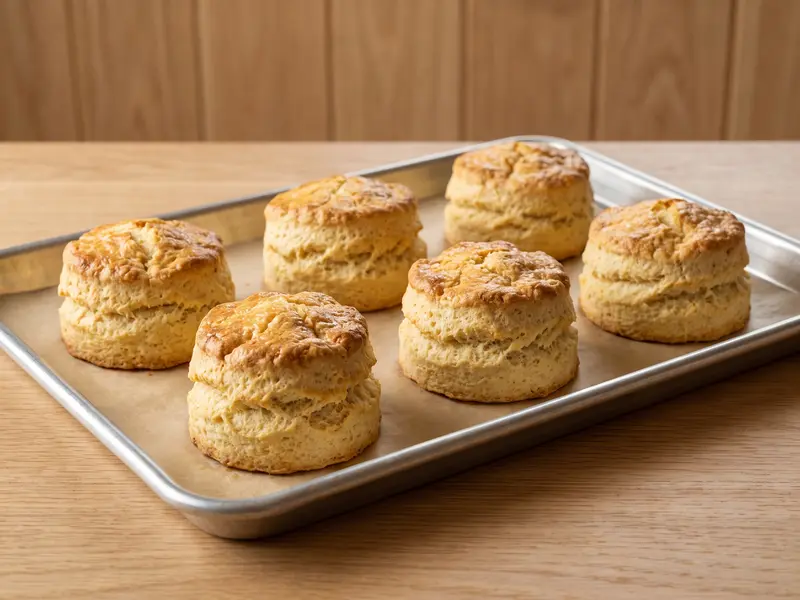
The natural split that appears around the middle of a well-made scone — called the waist — is the quality marker of proper technique: thick enough dough, cold butter, enough leavening, and a hot oven. To maximise the waist, do not flatten the dough below 3.5 cm. For raisin scones: soak the dried fruit in warm black tea for 30 minutes before using — this plumps the fruit and prevents it from drawing moisture from the dough. For cheese scones (a savoury variant): omit the sugar, vanilla, and dried fruit; add 100 g of grated mature cheddar and a pinch of cayenne to the crumb. The cream tea debate is serious in the south-west of England: Cornwall serves cream before jam on the scone; Devon serves jam before cream. The rest of Britain and most of the world ignores this controversy and eats them whichever way seems right.

Flour and Confectionery Products

Scones (British Buttermilk Scones)

By Sergei Martynov

Scones are the cornerstone of the British cream tea — a tradition in which scones are served warm, split horizontally, spread with clotted cream and jam, and eaten in the afternoon alongside a pot of tea. Originating in Scotland in the early sixteenth century and associated with Devon and Cornwall in the south-west of England, they are a quick bread (leavened by baking powder rather than yeast) made from flour, cold butter, buttermilk, and a little sugar. The defining technique is the same as pastry-making: very cold butter worked into flour until it resembles breadcrumbs, combined with cold liquid to just bring the dough together — never kneaded. The cold butter pockets in the dough hit the hot oven and release steam, creating the characteristic slight flakiness and the dramatic rise that splits the scone naturally along the middle — the 'waist' — making it easy to break open by hand without a knife.

⏱️
35
Minutes
👥
10
Servings
🔥
260
kcal
Rate this recipe

Key Ingredients

What you'll need

Ingredients

How to make it

Instructions

  1. 1

    Keep everything cold and preheat the oven. This is the foundational rule of scone-making: cold butter stays solid until it hits the hot oven, where it releases steam and creates flakiness. Warm butter melts into the dough, producing a dense, flat scone with no layers. Place the cubed butter in the freezer for 10 minutes before starting. Line a baking sheet with parchment paper. Preheat the oven to 220°C (425°F) — hot oven, fast bake.

  2. 2

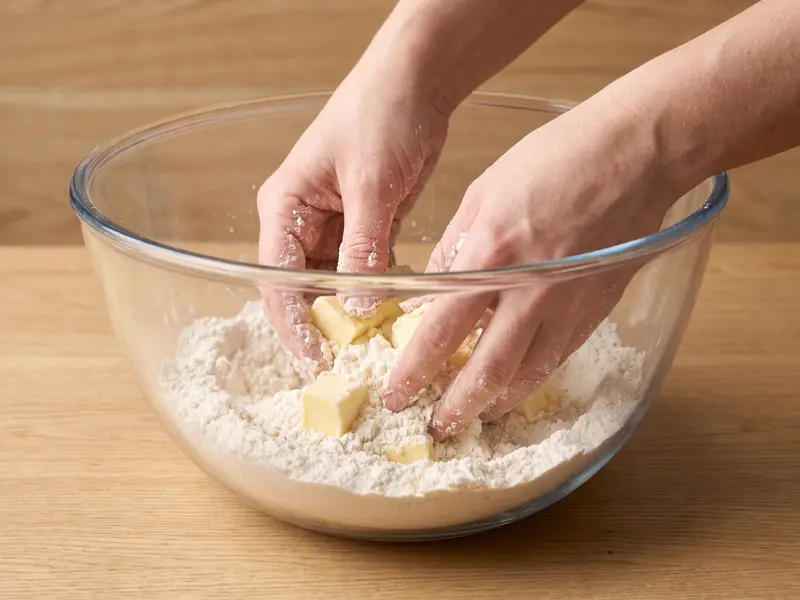
    Make the crumb. Sift the flour, baking powder, bicarbonate of soda, salt, and sugar into a large cold bowl. Add the cold butter cubes. Using your fingertips — working quickly and lightly — rub the butter into the flour, lifting and flicking the mixture to incorporate air, until the mixture resembles coarse breadcrumbs with pea-sized lumps of butter still visible. Do not work until completely smooth; those butter pockets are what create layers. If the butter has warmed up, refrigerate the bowl for 10 minutes before continuing.

  3. 3

    Combine and bring together. Whisk the cold egg, cold buttermilk, and vanilla extract (if using) together in a small bowl. Make a well in the centre of the flour mixture. Pour in the wet ingredients and add the dried fruit if using. Using a round-bladed knife or a fork, cut through the mixture in a crossing motion until the dough just barely comes together into a shaggy, rough mass. Stop mixing the instant it holds — overworking develops gluten and produces a tough, bready scone rather than a tender, crumbly one.

  4. 4

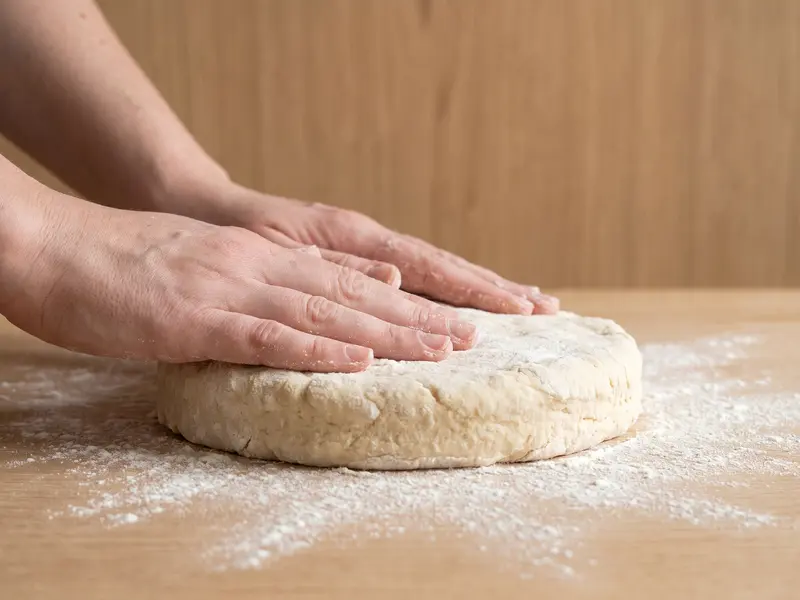
    Shape and cut — do not roll thin. Turn the dough onto a lightly floured surface. Pat — do not roll — with your hands to a thickness of 3 to 4 cm (1.5 inches). This thickness is critical: thinner than 3 cm and the scones will not rise significantly; the height comes from the starting thickness, not from oven spring alone. Use a floured 6 to 7 cm (2.5 inch) round cutter. Press straight down with a firm, decisive movement — do not twist, which would seal the edges and prevent the scone from rising straight. Space the cut scones 3 cm apart on the lined baking sheet. Brush the tops only with milk or buttermilk — not the sides, which would inhibit the rise.

  5. 5

    Chill briefly and bake. Refrigerate the shaped scones for 15 minutes — this firms the butter back up after handling, ensuring maximum rise. Bake at 220°C for 12 to 15 minutes until the tops are deep golden and the scones have risen to show a pale 'waist' around the middle where the dough naturally split. Transfer to a wire rack. Eat warm, split by hand along the natural waist, with clotted cream (or very cold thick cream) and strawberry or raspberry jam. The Devonian order: jam first, then cream. The Cornish order: cream first, then jam. Both are correct.

Join the conversation

Comments

Leave a comment

Loading comments…

Frequently Asked Questions

Why must the butter be cold and what happens if it is not?

Cold butter — ideally straight from the refrigerator or briefly from the freezer — remains in discrete pieces throughout the flour mixture even after rubbing in. When these cold butter pockets hit the hot oven, they melt and release steam rapidly, pushing the surrounding layers of dough apart. This creates the pockets of air within the crumb that give scones their characteristic tender, slightly layered texture and their height. If the butter is warm or soft before mixing, it coats the flour particles in an even fat layer rather than remaining as pockets. The fat then acts as a shortening agent that weakens gluten uniformly rather than creating discrete layers. The result is a dense, flat, sandy scone that lacks rise, texture, and layering.

Why should you never twist the cutter when cutting scones?

When you twist a round cutter as you press it through scone dough, the twisting action compresses and seals the edges of the cut circle. The sealed edge of dough cannot expand upward in the oven — the crust is too dense and bonded. The scone rises unevenly, often cracking sideways rather than lifting straight up, and may not develop the classic tall, straight sides. Pressing straight down with a firm, single, decisive motion and lifting cleanly keeps the cut edges open and layered, allowing the dough to expand upward freely and produce a scone with straight, tall sides and the characteristic waist.

What is clotted cream and how is it different from whipped cream?

Clotted cream is a very thick, rich cream produced by slowly heating full-fat cream to around 90°C over several hours, causing the fat globules to rise to the surface and 'clot' — coagulate into a dense, yellow, spreadable cream with a minimum fat content of 55%. It has a rich, faintly caramelised, nutty flavour that is entirely distinct from whipped cream. It is firm enough to spread with a knife and does not drip or run. Whipped cream is aerated cream that is light and delicate; it deflates quickly and has a much more neutral, milky flavour. They are not interchangeable. Clotted cream is produced primarily in Devon and Cornwall and is widely exported. If unavailable, the closest substitutes are very thick double cream (whipped very lightly), mascarpone, or crème fraîche.

What is the correct thickness for scones and why does it matter so much?

The correct thickness before cutting is 3 to 4 cm (approximately 1.5 inches). This thickness matters more than almost any other variable in scone-making. Scones do not puff dramatically in the oven the way bread does — they rely on a combination of the steam from cold butter and the action of the baking powder, and the final height is approximately the same as the starting height. A scone cut from dough that is 2 cm thick will produce a flat, dense finished product of roughly 3 cm; a scone cut from dough that is 4 cm thick will produce a tall, impressive result of 5 to 6 cm with a clear waist. Most recipes that produce disappointing, flat scones have dough that was rolled or patted too thin.

What is the Cornwall versus Devon debate about serving cream teas?

The cream tea — scones, clotted cream, jam, and tea — is contested between two neighbouring counties in the south-west of England who each claim the original and correct method of assembly. In Cornwall, the tradition is to spread the scone first with cream and then place the jam on top of the cream. In Devon, the order is reversed: jam first, then cream on top of the jam. Both counties have been making this argument with considerable regional pride for at least a century. The practical culinary difference is minimal since both components end up in the same mouth. In 2010, the Cornish Pasty Association obtained protected geographic status for the Cornish cream tea method; Devon has since lobbied for equivalent recognition. Neither side has conceded.