


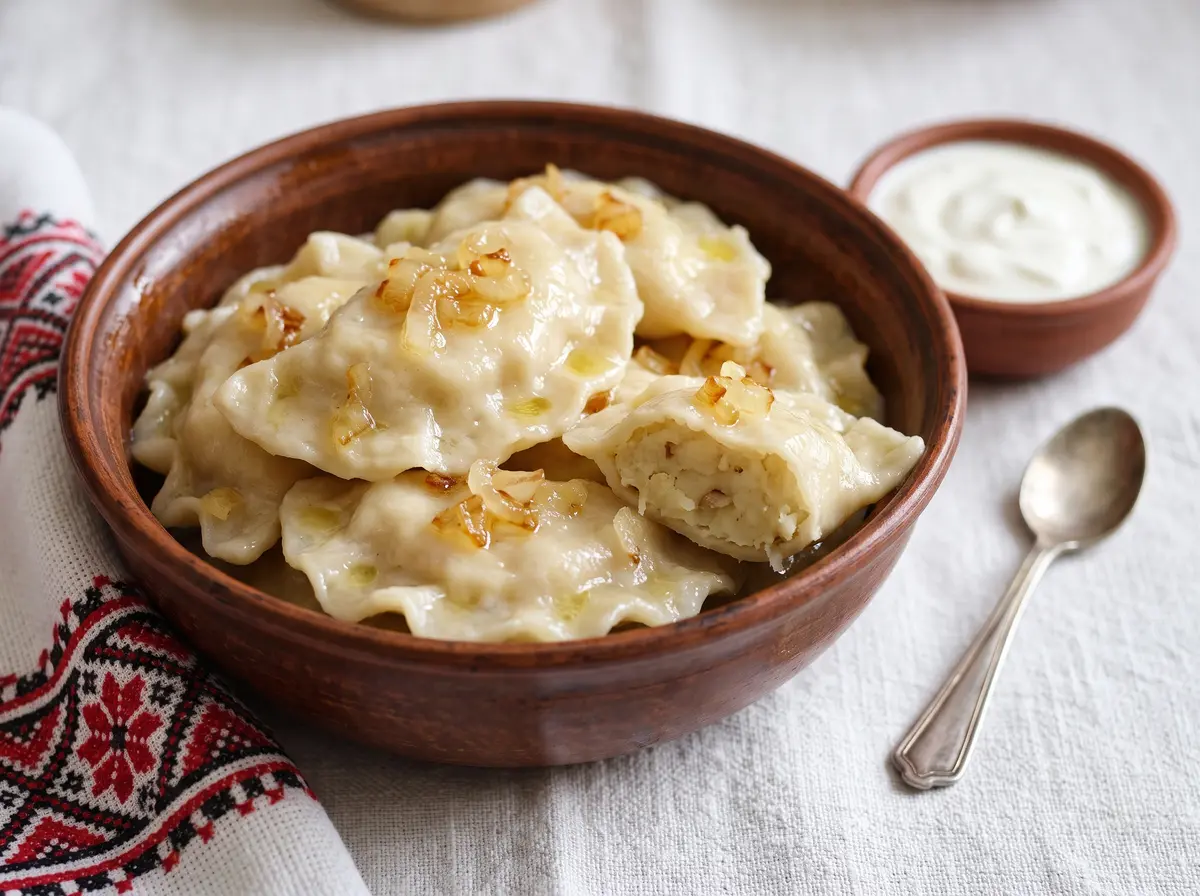
Varenyky with Potatoes
Varenyky with potatoes (вареники з картоплею, spelled Wareniki in German) are Ukrainian boiled dumplings: a thin unleavened dough of flour, water and oil folded around mashed potato with fried onion. The dough is mixed with hot water and kneaded until it stops sticking to your hands, then rolled out and cut into circles with a glass. From peeling the potatoes to the last batch out of the pot takes about 2 hours, including 30 minutes of rest for the dough. They are traditionally served with sour cream and the second half of the golden onion poured over the top.
What varenyky with potatoes are
Varenyky (вареники, also written vareniki, and Wareniki in German) are Ukrainian dumplings of unleavened dough, cut into circles, filled, folded into half-moons and boiled. Potato with fried onion is the classic savoury filling. Most Ukrainian cooks are used to a dough made with water, though kefir and egg doughs exist too. A water dough has no egg and no dairy, so it is lenten.
Poland has a close relative. According to Yevhen Klopotenko, Polish cooks put potato and curd cheese into one filling, while Ukrainians would rather make two kinds. Onion fried with salo over the top is common to both countries.
Varenyky on the Ukrainian Holy Supper
On Holy Supper (Святвечір), the evening before Christmas, the table holds 12 lenten, meatless dishes, and varenyky are among them. In Ukraine it falls on 24 December by the new church calendar, and on 6 January for those who keep the old style.
For that evening the filling is lenten, such as cabbage, potato or mushrooms, and the varenyky are often served with fried onion. This recipe needs only one change to fit: leave out the sour cream.
Ingredients
- 500 gpotatoes
- 1 tspsalt
- 300 gwheat flour
- 0.5 tspsalt
- 150 mlwater
- 1.5 tbspvegetable oil
- 2 onion
- 4 tbspvegetable oil
- 0.5 tspsalt
- 0.5 tspground black pepper
- 30 gwheat flour
- 4 lwater
- 2 tspsalt
- 200 gsour cream
Method
- You need 500 g of floury potatoes after peeling, the kind you would use for mash (about 600 g before peeling). Peel them and cut them into large chunks of about the same size. Put them in a 2 to 3 litre saucepan, cover with cold water, add 1 tsp salt and bring to the boil over high heat, then turn the heat down to medium and simmer for 15 to 20 minutes, until a knife slides into a chunk with no resistance. Drain well and put the potatoes back in the hot pan off the heat until the steam dies down. Mash them with a masher and don't add milk. A firm, dry mash holds its shape inside the dumpling.
- While the potatoes cook, make the dough. Mix 300 g wheat flour with 0.5 tsp salt in a large bowl and make a well in the middle. Pour in 150 ml hot water (hot, but not boiling) and 1.5 tbsp sunflower or other vegetable oil and stir with a fork until shaggy. Once it is cool enough to handle, knead it on the counter for 7 to 10 minutes, until the dough is smooth and elastic and no longer sticks to your hands. Cover it and leave it at room temperature for 30 minutes. The rest relaxes the gluten, and the dough becomes easier to roll and shape.
- Finely dice 2 medium onions, about 120 g each. Heat 4 tbsp oil in a 24 to 26 cm frying pan over medium heat and fry the onion for 7 to 10 minutes, stirring, until it is soft and golden. Spoon half of the onion, with half of the oil, into the mashed potato. Leave the other half in the pan for serving.
- Stir 0.5 tsp salt and 0.5 tsp ground black pepper into the potato and onion and taste. Spread the filling on a large plate and leave it until it is no longer warm to the touch. A cool filling holds its shape on the spoon, so you can portion it neatly.
- Cut the dough in half and keep one half covered. Dust the counter with some of the 30 g flour and roll the dough out to 1.5 mm. Cut circles with a glass 8 cm across. Press the scraps together, cover them and roll them out again later. Dust the circles lightly with flour and stack them so they don't stick.
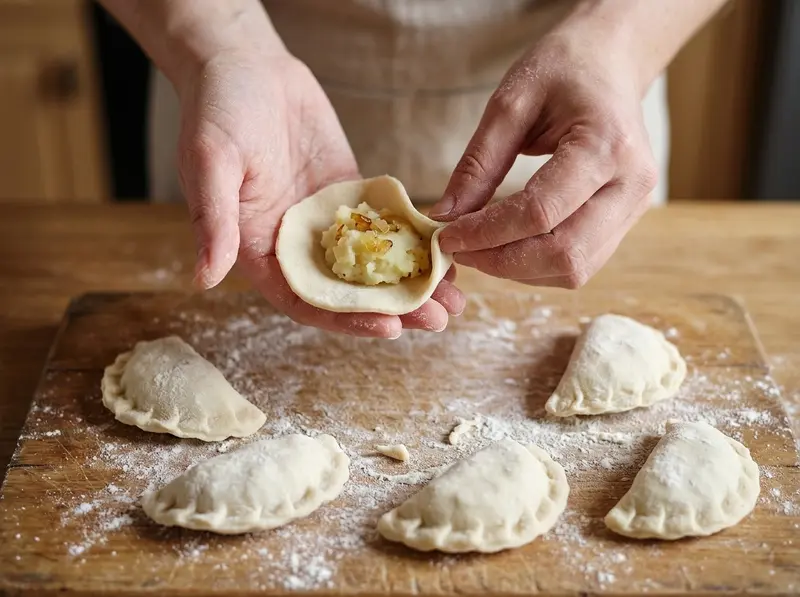
- Put 2 tsp of filling (about 12 g) in the middle of each circle and keep the edge clean. Fold the circle in half and pinch the edge shut with your fingertips from one end to the other, then fold the crest over on itself in small pleats. If the edge has dried out, dab it with a wet finger. There should be no gaps and no filling caught in the seam: varenyky that are overfilled or badly sealed open up in the boiling water. Lay them on a floured board without touching. You will get 48 to 60, depending on how thin you roll the dough; any extra circles can take a little less filling.
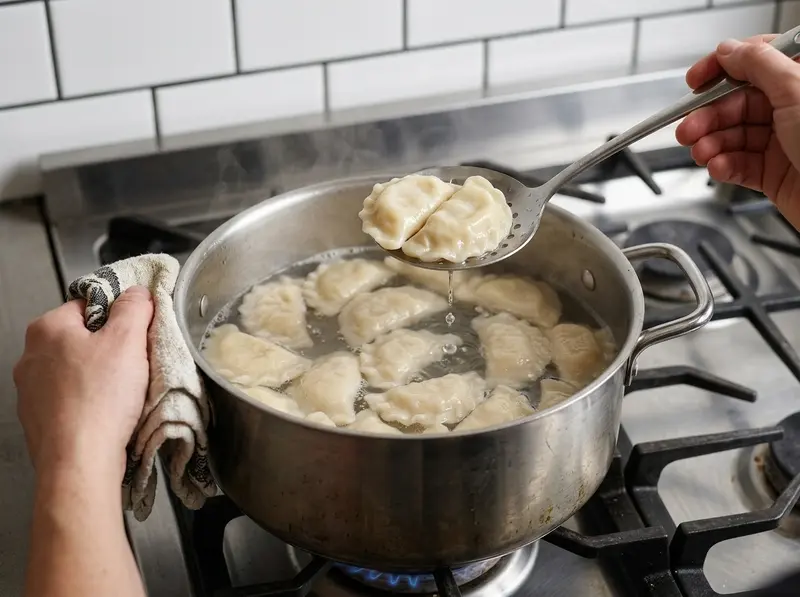
- Bring 4 litres of water to a rolling boil in a 5 to 6 litre pot and add 2 tsp salt. Drop in 16 varenyky and stir once, gently, so they don't stick to the bottom. They float after about 5 minutes. Turn the heat down to a gentle boil and cook for 3 minutes more. Only the dough needs cooking, because the filling is cooked already. Bite into one: the pinched edge should be tender, with no floury core. Lift them out with a slotted spoon into a warm bowl, spoon 1 tbsp of the onion oil over them, toss gently and cover so they stay hot and don't stick together. Cook the other batches the same way, bringing the water back to the boil each time.
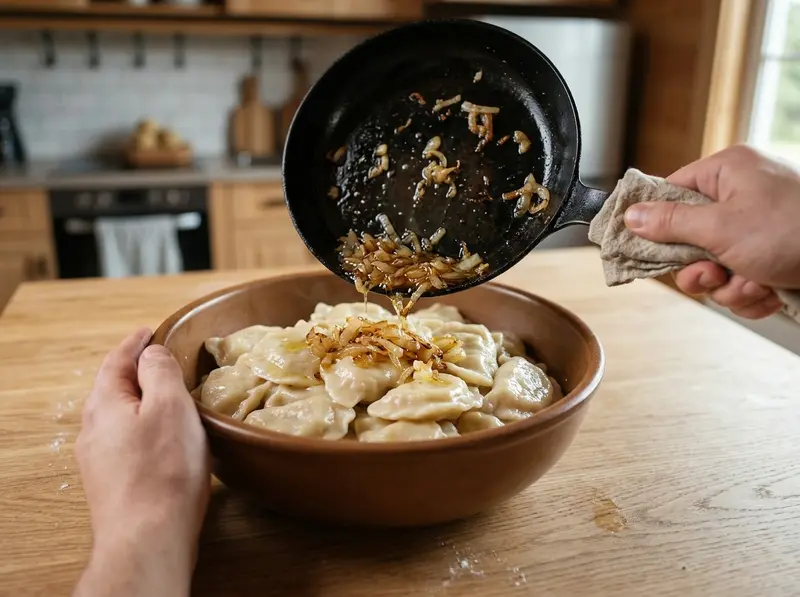
- Warm the reserved onion in its pan over low heat. Pour the rest of the onion and its oil over the varenyky in the bowl and toss gently so each one is coated and they don't stick together. Serve with 200 g sour cream on the side. Put leftovers in the fridge within 2 hours and eat them within 3 to 4 days. Reheat them by frying in a little oil until golden on both sides and hot all the way through, 74 °C.
Cooked it? Rate the recipe
FAQ
They are close relatives: both are boiled half-moon dumplings, and both are often served with onion fried with salo. The first difference Yevhen Klopotenko names is the filling. In the Polish version potato with fried onion and curd cheese go into one double filling, while Ukrainians would rather make two separate kinds of varenyky. The second is that his Polish-style varenyky are fried in a pan after boiling. The dough here is the everyday Ukrainian one, made with water and oil and no egg, and sweet varenyky are shaped and boiled the same way, see varenyky with cherries.
Usually the seam is to blame. Use no more than 2 tsp of filling per 8 cm circle, keep the edge clean, pinch it shut along its whole length and fold the crest over in small pleats. Cook about 16 at a time in 4 litres of water at a rolling boil, stir once so they don't stick to the bottom, and take them out 3 minutes after they float.
Freeze them raw. Lay the shaped varenyky on a floured board so they don't touch and put the board in the freezer for 2 hours, until they are hard. Then tip them into a freezer bag dusted with flour, write the date on it and use them within 1 month. Don't thaw them: drop them straight into salted boiling water and stir once so they don't stick together. Frozen varenyky take around 10 to 12 minutes in all.
The dough in this recipe is flour, water, salt and oil with no egg, and the filling is potato and onion fried in oil. Leave out the sour cream and the dish is vegan, which also makes it a lenten dish. For allergies: the dough contains wheat (gluten) and no egg, and the sour cream is the only dairy. Varenyky are one of the 12 lenten, meatless dishes of the Holy Supper, held on 24 December by the new church calendar and on 6 January by those who keep the old style. On that evening varenyky come with a lenten filling such as potato and are often served with fried onion, exactly as here.
The classic pairing is sour cream, about 50 g per person, plus the fried onion and its oil poured over the top. For shkvarky, cut 100 g of salo (pork fat) or bacon into small cubes and fry them in a dry pan until golden and crisp, then warm the reserved fried onion with them for a minute and pour everything over the varenyky with the fat. With shkvarky the dish is no longer vegetarian. Leftover varenyky are good the next day fried in a little oil until golden on both sides.
Keep browsing
More dishes from the Ukrainian archive — picked by overlap with what you're cooking now.



Recipes by email
One letter a week: a recipe picked for your taste, plus whatever is new on the site. You can stop the letters in one click.
Welcome gift: Sergei's cookbook (e-book).
By signing up for the newsletter you agree to the privacy policy.
Tell us what you like to cook (30 seconds) →
Join the conversation
Comments
No comments yet — be the first!