Skip to content
GetCookMatch
⌘K
Ingredient

Garlic Recipes

86 recipes with garlic for weeknights, meal prep, and quick ingredient searches. Choose by time, cuisine, and what is in your kitchen.

Crispy Cabbage Caesar Salad
🇺🇸USAMedium
Salads

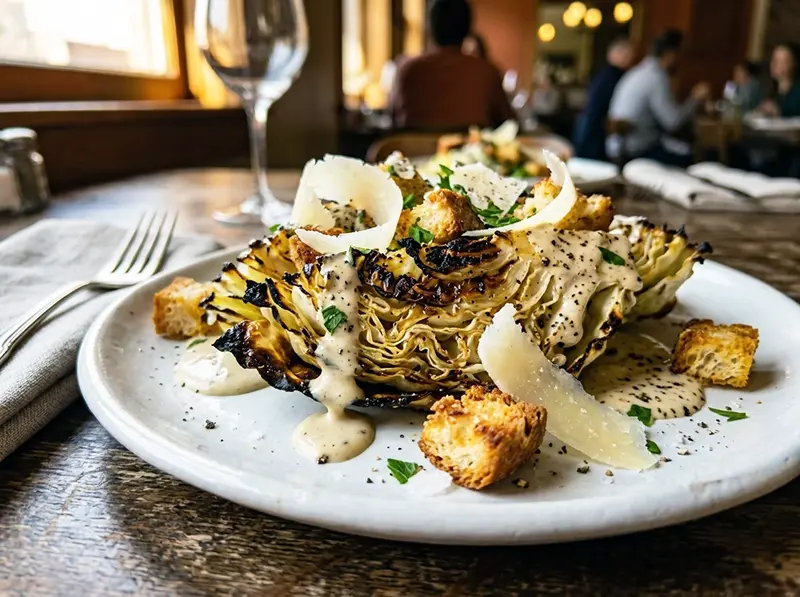
Crispy Cabbage Caesar Salad

Roasted cabbage Caesar salad with caramelized wedges, homemade anchovy dressing, crunchy croutons, and shaved parmesan. The cabbage goes into a screaming-hot oven until the edges char and the natural sugars turn to toffee — then gets the full Caesar treatment. A whole head of cabbage feeds four people for almost nothing, and it tastes better than romaine ever did.

25 min290 kcal4 serves
Quick
4.8
Asparagus and Marinated Artichoke Galette
🇺🇸USAAdvanced
Vegetable and Mushroom Dishes

Asparagus and Marinated Artichoke Galette

Savory free-form tart with asparagus spears and oil-packed artichoke hearts on a lemony herbed cream cheese base. The dough takes five minutes and no food processor — just cold butter grated directly into flour. Once it comes out of the oven with the crust dark and blistered and the cheese puffed at the edges, it looks like something you'd pay $18 for at a spring brunch spot.

75 min385 kcal6 serves
🌿Vegetarian🌶️Spicy
4.7
Mushroom, Spring Onion and Chilli Crisp Filo Bake
🇬🇧UKMedium
Vegetable and Mushroom Dishes

Mushroom, Spring Onion and Chilli Crisp Filo Bake

Layers of shattering filo pastry wrapped around a savory mushroom and spring onion filling, every sheet brushed with a mix of melted butter and chilli crisp. The result is somewhere between a Turkish börek and an Asian-inspired bake — deeply golden on top, fragrant with sesame and chilli oil, with the filling still juicy inside. One of those dishes where the technique is simple but the payoff looks and tastes unreasonably good.

55 min295 kcal6 serves
🌿Vegetarian🌶️Spicy
4.5
Homemade Strasbourg-style Pâté en Croûte
🇫🇷FranceAdvanced
Meat Dishes

Homemade Strasbourg-style Pâté en Croûte

A home kitchen adaptation of the classic Strasbourg pâté — no foie gras, but the same principle: spiced, cognac-scented forcemeat baked inside a golden pastry crust and sliced cold.

120 min365 kcal8 serves
💪High protein
4.4
Whipped Feta with Hot Honey and Pistachio
🇬🇷GreeceMedium
Sauces and Dips

Whipped Feta with Hot Honey and Pistachio

Whipped feta with hot honey and pistachio is a creamy salty-sweet mezze dip — block feta blended with Greek yogurt, lemon zest, and olive oil into a fluffy spread, then drizzled with chili-infused honey and topped with toasted pistachios. The contrast is the whole point: salty fermented sheep's milk against sweet floral honey with a slow chili burn, and crunchy pistachio against the silky base. Comes together in under 15 minutes in a food processor and serves six on a mezze board with warm pita, crackers, or sliced pear. The hot honey is easy to make at home if you cannot find it in shops.

15 min230 kcal6 serves
🌿Vegetarian💪High proteinQuick
4.5
Gochujang Mayo (Korean Spicy Mayonnaise Sauce)
🇰🇷KoreaEasy
Sauces and Dips

Gochujang Mayo (Korean Spicy Mayonnaise Sauce)

Gochujang mayo is a Korean-inspired spicy condiment built on Japanese Kewpie mayonnaise, fermented gochujang chili paste, rice vinegar, toasted sesame oil, and garlic. The mayo cools and rounds out the heat, the gochujang brings deep fermented umami, sesame oil signs the sauce as Korean. Whisks together in five minutes, lives in the fridge for a week, and works on Korean fried chicken, sweet potato fries, poke bowls, burgers, sushi, and as a sandwich spread. Serves about eight as a dipping sauce. The 30 minute rest in the fridge before serving is what separates a punchy mix from a balanced sauce.

5 min110 kcal8 serves
🌶️SpicyQuick
4.5
Brandade de Morue (Provençal Salt Cod and Olive Oil Spread from Nîmes)
🇫🇷FranceMedium
Sauces and Dips

Brandade de Morue (Provençal Salt Cod and Olive Oil Spread from Nîmes)

Brandade de Morue is the southern French classic from Nîmes (Languedoc-Roussillon), an emulsion of desalted cod, olive oil, milk, and garlic. The name comes from Occitan 'brandar' — to stir, to shake — describing the vigorous beating that turns flaked cod and oil into a creamy spread. First documented by Charles Durand in 1830, the original Nîmes version contains no potato — that addition is a 19th-century Parisian shortcut. This recipe follows Durand's purist tradition: cod-collagen emulsion, no shortcuts. Spread on toasted baguette, baked into a gratin, or used as a dip with raw vegetables. High in protein, naturally gluten-free, low in carbohydrates (keto-friendly when no potato is added). Active time 40 minutes plus 24-48 hours of soaking the salt cod. Yields about 600 g, serves 8 as appetizer with crostini, salad, and chilled rosé.

40 min310 kcal8 serves
💪High protein🌾Gluten-free🥑Keto
4.8
Italian Salsa Verde (Piedmontese Bagnet Verd Green Sauce)
🇮🇹ItalyEasy
Sauces and Dips

Italian Salsa Verde (Piedmontese Bagnet Verd Green Sauce)

Italian salsa verde — known as bagnet verd in Piedmontese dialect — is the punchy raw green sauce of Northern Italy. Built on flat-leaf parsley, anchovies, capers, garlic, hard-boiled egg yolk, vinegar-soaked bread, and olive oil, it is the obligatory condiment for bollito misto (mixed boiled meats), the wintertime ceremony of Piedmont. The recipe traces back to the Vie del Sale, the ancient salt routes that connected Liguria's coast to Piedmont's inland valleys, bringing olive oil, salt, and anchovies into mountain kitchens. Bright, salty, sharp, herbaceous — designed to cut through the richness of long-cooked meat. Versatile far beyond bollito: spoon over grilled fish, roasted vegetables, soft cheese, hard-boiled eggs, or crostini. Active 20 minutes, plus 1-2 hours of resting at room temperature for flavours to integrate. Yields about 250 ml, serves 8 as condiment to a main course.

20 min180 kcal8 serves
Quick
4.7
Italian Salsa Rossa (Piedmontese Bagnet Ross Tomato Sauce)
🇮🇹ItalyAdvanced
Sauces and Dips

Italian Salsa Rossa (Piedmontese Bagnet Ross Tomato Sauce)

Italian salsa rossa — known as bagnet ross in Piedmontese dialect — is the second obligatory condiment for bollito misto, the winter ceremony of mixed boiled meats from Northern Italy. It is the red sibling of the more famous salsa verde (bagnet verd): a slow-cooked purée of ripe tomatoes, yellow onion, carrot, celery, and garlic, balanced with a touch of sugar and red wine vinegar, finished with extra virgin olive oil. The traditional Nonna Titta version contains no bell pepper, no spices — pure vegetable depth, sweet and tangy, mildly hot from a pinch of peperoncino. The name 'salsa rubra' (Latin for red) was popularized in 1930s Italy when the Cirio company ran a contest under Mussolini's foreign-words ban to find an Italian name for ketchup — Rubra and Vesuvio won. Modern restaurants often use bagnet ross and salsa rubra interchangeably. Naturally vegan and gluten-free. Active 15 minutes plus 60 minutes simmer. Yields about 600 ml, serves 10 as condiment.

75 min120 kcal10 serves
🌾Gluten-free🌱Vegan🌶️Spicy
4.7
Italian Bagna Cauda (Piedmontese Hot Anchovy and Garlic Dip)
🇮🇹ItalyMedium
Sauces and Dips

Italian Bagna Cauda (Piedmontese Hot Anchovy and Garlic Dip)

Bagna cauda — Piedmontese dialect for 'hot bath' — is the ancient warm dip of olive oil, garlic, and anchovies that defines Northern Italian conviviality. Slowly melted into a single silky emulsion, kept warm at the centre of the table in a terracotta fujòt over a candle, surrounded by raw and cooked seasonal vegetables and crusty bread for dipping. Origins trace to medieval Piedmont and the Strada Salis (the salt road) that brought anchovies and salt from Provence and Nice into landlocked Piedmontese valleys, fueling a cuisine built on cured fish far from the sea. In 2005 the Asti Delegation of the Italian Academy of Cuisine officially registered the recipe with a notary in Costigliole d'Asti. Every November-December Asti celebrates Bagna Cauda Day. This domestic balanced version uses milk-poached garlic for elegance, salt-packed anchovies for depth, and a finishing knob of butter for silky texture. Active 25 minutes plus 15 minutes milk-poach. Yields about 300 ml, serves 6 as a centerpiece dip.

40 min350 kcal6 serves
🌾Gluten-free🥑Keto
4.6
Italian Pesto al Limone (Ligurian Basil and Lemon Pesto)
🇮🇹ItalyEasy
Sauces and Dips

Italian Pesto al Limone (Ligurian Basil and Lemon Pesto)

Pesto al limone is the Ligurian variation of classic Pesto alla Genovese with the addition of lemon zest and juice — turning the herb-paste into a fresh citrus-herb sauce. The combination of fresh Genovese basil, toasted pine nuts, Parmigiano-Reggiano, garlic, lemon, and delicate Ligurian olive oil produces a bright emerald-green sauce with a floral-citrus lift that classical pesto lacks. Origins are the Liguria coastline (Cinque Terre, Portofino, Genoa region), home to Italy's finest basil DOP and world-class olive oils. Lemon is the key differentiator: the acid balances olive oil richness, brightens the basil, stabilizes the emerald colour longer than classical pesto, and turns the sauce into a versatile year-round condiment. A separate Procida-style lemon pesto exists from southern Italy (parsley + mint + walnuts, no basil), but this is the Ligurian school. Active 15 minutes including pine nut toasting. Yields about 250 ml, serves 6 as pasta sauce or condiment.

15 min210 kcal6 serves
🌿Vegetarian🌾Gluten-freeQuick
4.8
Ribollita (Tuscan Reboiled Bread and Bean Soup)
🇮🇹ItalyAdvanced
Soups

Ribollita (Tuscan Reboiled Bread and Bean Soup)

Ribollita is a thick Tuscan soup of cannellini beans, cavolo nero (black kale), and stale bread — one of the central symbols of cucina povera (peasant cooking). The name means 'reboiled' (from the Italian ribollire), and that is the whole point of the dish: it is born from leftovers. Tuscan peasants would cook a simple vegetable soup called minestra early in the week, then the next day reheat what remained with the addition of stale bread, turning minestra into ribollita. The paradox of the dish is that it gets better the longer it sits and the more times it is reboiled. On day one it is still a brothy minestra di pane; on day two, after reboiling, it becomes true ribollita — dense and almost semi-solid. Its roots reach back to the Middle Ages in the plain of Pisa and the lands of Arezzo and Florence, where it was the main winter nourishment of the poorest. The three non-negotiable elements are cannellini beans, cavolo nero, and saltless Tuscan bread (pane sciocco), which stales within a day. By tradition the cavolo nero should have 'taken the frost,' which makes its leaves sweeter and more tender. Key techniques: blend half the beans for a creamy base without any cream, tear the stale bread by hand, and use potato plus bread as a double thickener until the soup is dense enough to serve almost on a plate. Yields 6 servings in about 2 hours of active and simmering time. Best the next day, served hot over garlic-rubbed toast with a generous pour of extra virgin olive oil and a glass of Chianti.

120 min280 kcal6 serves
🌱Vegan
4.6
Ingredients

Goes well with

Other ingredients that appear most often alongside garlic across the archive. Pick one to drill deeper.