


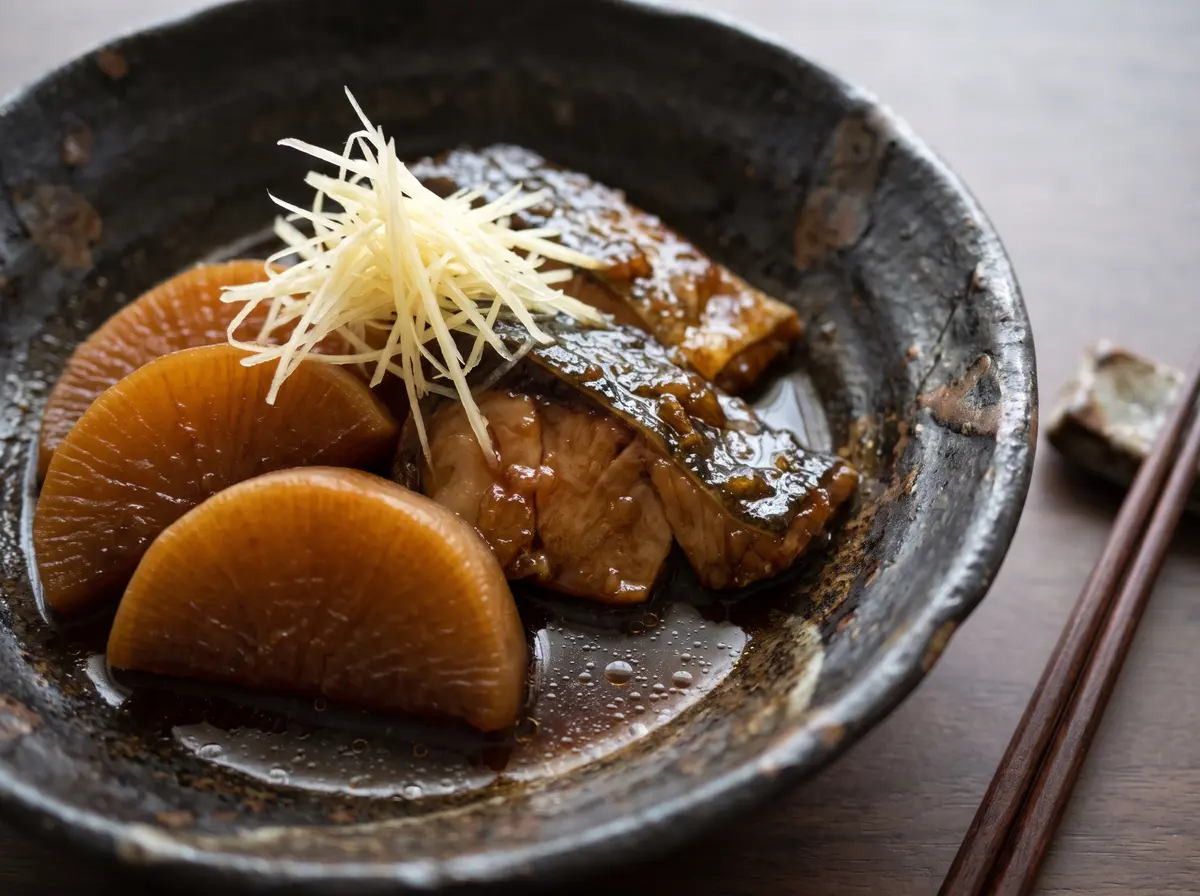
Buri Daikon (Japanese Simmered Yellowtail and Daikon)
Buri daikon (ぶり大根, also written ブリ大根) is a Japanese winter home dish of yellowtail, called buri, simmered with thick pieces of daikon radish in soy sauce, sake, mirin and sugar. It is a traditional dish of Toyama, where cooks make it from buri ara, the head, collar and bones left after cutting sashimi. This version uses skin-on fillets, which are easier to buy outside Japan. The daikon is cooked separately first, so the fish simmers for about 25 minutes. The fish is scalded and rinsed before it goes in the pot, and that step is what keeps the broth clean and free of fishy smell. It takes about 65 minutes, plus a 30-minute rest off the heat while the daikon soaks up the broth.
What buri daikon is
Buri daikon pairs two winter ingredients: fatty yellowtail and sweet, juicy daikon radish, simmered in soy sauce, sake, mirin and sugar with slices of ginger. As Just One Cookbook points out, it needs no dashi, unlike most Japanese simmered dishes, because the yellowtail gives the broth plenty of flavour. Some cooks still add kombu, as in Ishikawa and in Tokiko Suzuki's NHK recipe.
Japan's farm ministry describes it as a traditional dish of Toyama, made at home and in restaurants through the winter, when buri comes south into Toyama Bay with the catch peaking from December to January. The classic Toyama version uses buri ara, the head and bones sold after the fillets are cut for sashimi. Some families there season it with miso instead of soy sauce.
Buri, hamachi and other names for yellowtail
Buri is a fish that changes its name as it grows. Just One Cookbook lists inada or hamachi at about 30 cm, warasa or mejiro at about 60 cm and buri at about 90 cm, with the names differing between Tokyo and Osaka. Today hamachi usually means the farmed fish sold for sushi in Japan and the US, and the fatty wild buri of winter is called kanburi.
Just One Cookbook's recipe calls for either hamachi or buri fillets. Pick fillets with the skin on, about 100 g each, so they keep their shape during the 25 minutes of simmering.
Ingredients
- 600 gdaikon
- 2400 mlwater
- 2 tbspuncooked short-grain rice
- 400 gskin-on yellowtail fillets
- 0.5 tspfine salt
- 30 gginger
- 100 mlsake
- 3 tbspmirin
- 25 gsugar
- 4 tbspsoy sauce
Method
- Cut the 600 g daikon into 2 cm rounds. Peel each round thickly, 3 to 4 mm deep, until the stringy ring just under the skin is gone, because those fibres stay tough however long they cook. Halve any round wider than 5 cm into half-moons, then shave a thin strip off the cut edges with the knife. Rounded edges don't crumble in the pot.
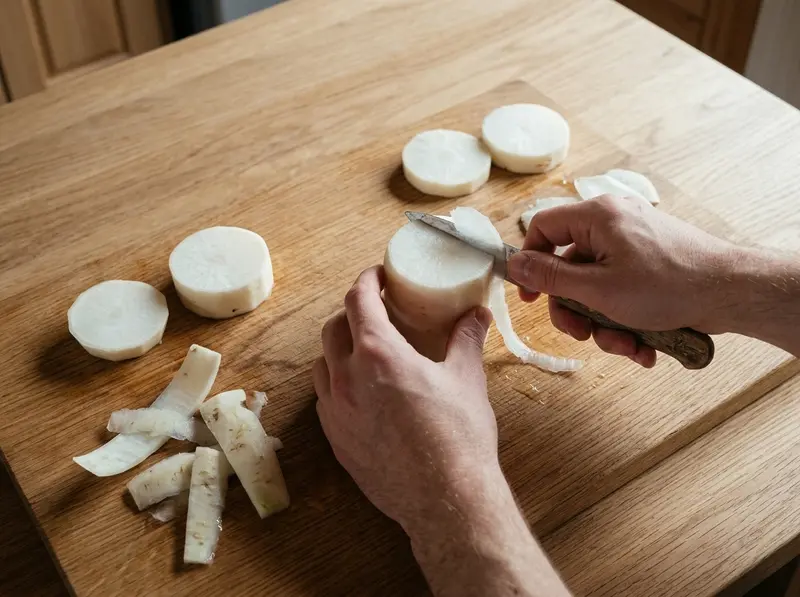
- Put the daikon in a wide 24 cm pot (about 3 L) with 1000 ml of the water and the 2 tbsp rice, starting from cold water. If you drop daikon into boiling water, the outside falls apart before the middle softens. Bring to a boil over high heat, then turn to low and cook for 15 to 20 minutes, until a skewer slides in easily and the edges look translucent. Japanese cooks believe the rice takes away the radish's bitterness. Drain, rinse the daikon and the pot under cold water, and set the daikon aside.
- While the daikon cooks, cut each of the 4 skin-on yellowtail fillets (400 g in total) in half, into pieces about 5 cm long. Sprinkle the ½ tsp fine salt over both sides, skin included, and leave for 10 minutes. Peel the 30 g ginger. Slice 20 g of it thinly for the pot and cut the remaining 10 g into very fine matchsticks for serving.
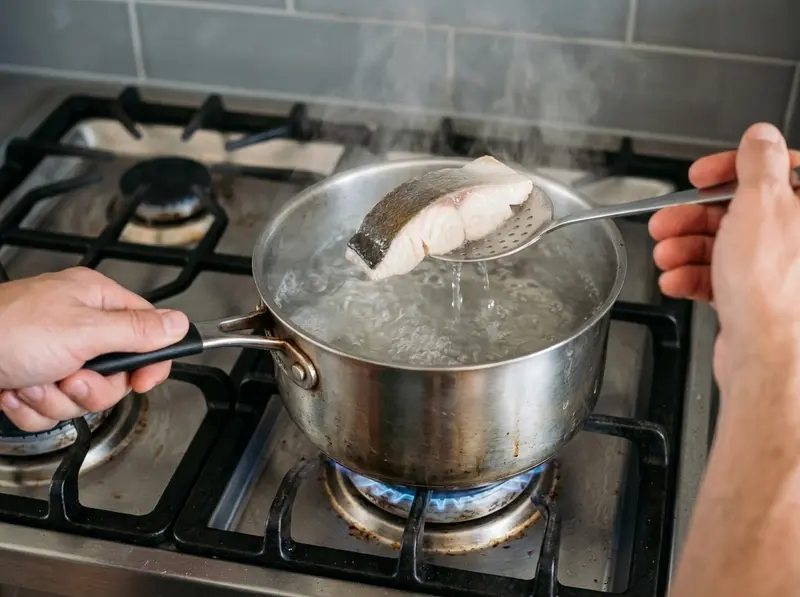
- Bring another 1000 ml of the water to a boil in an 18 cm saucepan. Lower in the fish 3 or 4 pieces at a time for 10 to 15 seconds, just until the surface turns white, then lift them into a bowl of iced water. The inside should still be raw. Under cold running water, rub off any leftover scales, dark blood and slime, then pat the pieces dry. This scalding is called shimofuri, and it takes away the fishy smell and helps the pieces hold together in the pot.
- Lay the daikon in one layer in the rinsed 24 cm pot, put the fish on top skin side up and scatter over the ginger slices. Add the remaining 400 ml water, the 100 ml sake, 3 tbsp mirin and 25 g sugar (2 tbsp). Bring to a boil over high heat, skim off the grey foam and lay a drop lid (otoshibuta) right on the food: a wooden one soaked in water first, or a 22 cm circle of baking parchment with a small slit or hole cut in the middle. The liquid won't cover the fish, and that is expected: the drop lid keeps it washing over the top while steam escapes, which an ordinary lid would not do. Simmer on medium-low, bubbling steadily, for 10 minutes.
- Lift the drop lid, pour in the 4 tbsp soy sauce and tilt the pot gently to mix it into the broth. Some Japanese cooks, among them Yoshiharu Doi on NHK and Shirogohan.com, add the sugar first and the soy sauce a little later, as here. Put the drop lid back and simmer on medium-low for 10 minutes more, until the daikon turns light brown.
- Take the drop lid off and raise the heat to medium. For 5 minutes, keep spooning the broth over the fish and daikon until it has cooked down to about a third and looks glossy. Stop before the pot runs dry. The fish is done when the flesh is opaque all the way through and flakes at the thickest part (63°C). A skewer should slide into the daikon with no resistance.
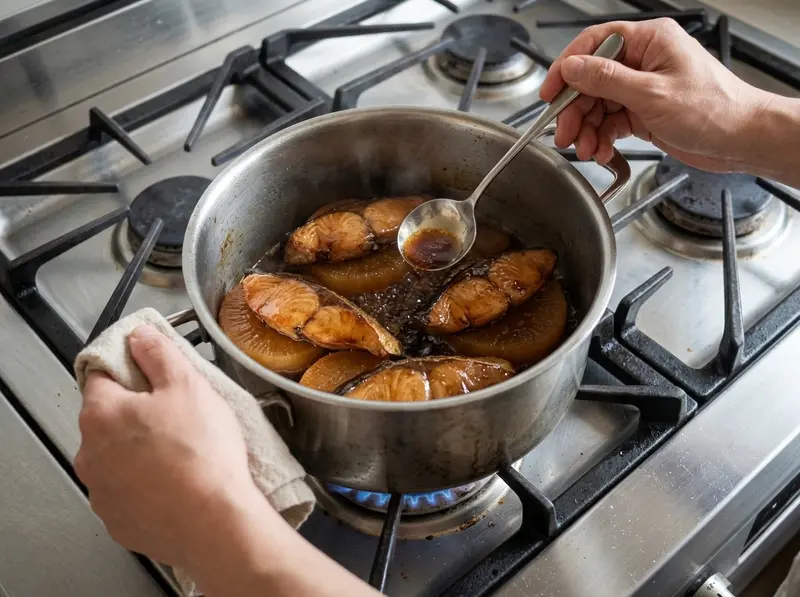
- Turn off the heat, lay the drop lid back on and let the pot rest for 30 minutes, tilting it once to coat the daikon. The daikon keeps taking up the broth as it cools. Warm it through again if you like, serve in bowls with a little broth and put the ginger matchsticks on the fish. Get leftovers into the fridge within 2 hours of turning off the heat, counting the 30-minute rest. Eat them within 2 to 3 days and reheat until steaming hot, 74°C in the middle.
Cooked it? Rate the recipe
FAQ
Buri daikon is yellowtail simmered with daikon radish in soy sauce, sake, mirin and sugar, a home dish of the cold months. Japan's farm ministry lists it as a traditional dish of Toyama, where buri catches in Toyama Bay peak from December to January, and in Ishikawa the season runs from November to February. In Toyama it is traditionally made from buri ara, the head, collar and bones left after cutting sashimi. Because buri changes its name as it grows, it counts as a lucky fish, and the ministry notes it also appears at New Year meals. This recipe uses fillets, which are easier to find outside Japan.
First look for hamachi, the farmed young yellowtail sold for sushi in Japanese and Asian shops, which is the same fish. Just One Cookbook also suggests amberjack, salmon, mackerel, cod or sea bream. Whatever you use, buy skin-on fillets of about 100 g each, because the skin keeps the pieces from breaking up in the pot.
A fishy broth most often comes from skipping or rushing the shimofuri step. Salt the pieces for 10 minutes, dip them in boiling water for 10 to 15 seconds until the surface turns white, then rub off scales, blood and slime in iced water before they go in the pot. Tough fish comes from simmering fillets too long. That is why this recipe cooks the daikon first, so the fish spends 25 minutes in the broth instead of the 35 to 40 minutes that raw daikon would need. The chef Hiromitsu Nozaki, in his recipe for NHK's Kyō no Ryōri, goes further and lifts the fish out while the daikon finishes, then puts it back at the end.
Yes to both. Plain water works for pre-cooking the daikon, as long as you start it cold and cook it until a skewer slides in. Kikkoman's recipe uses the microwave instead, 7 to 8 minutes at 600 W for 350 g of 1.5 cm half-moons, so thicker 2 cm pieces or a bigger batch will need longer and a skewer test. In place of a drop lid, cut a circle of baking parchment slightly smaller than the pot and snip a small hole in the middle, or lay kitchen paper or foil on the food. The same pre-cook with a little rice is used for the daikon in oden.
Covered in the fridge it keeps 2 to 3 days, and yes, it usually tastes better the next day. Just One Cookbook and Japan's farm ministry both say that a night's rest lets the daikon soak up more of the broth, the same way nikujaga improves overnight. Get it into the fridge within 2 hours of turning off the heat. Reheat gently until it is steaming hot, 74°C in the middle. Just One Cookbook says it also freezes for up to a month.
Keep browsing
More dishes from the Japanese archive — picked by overlap with what you're cooking now.




Recipes by email
One letter a week: a recipe picked for your taste, plus whatever is new on the site. You can stop the letters in one click.
Welcome gift: Sergei's cookbook (e-book).
By signing up for the newsletter you agree to the privacy policy.
Tell us what you like to cook (30 seconds) →
Join the conversation
Comments
No comments yet — be the first!