
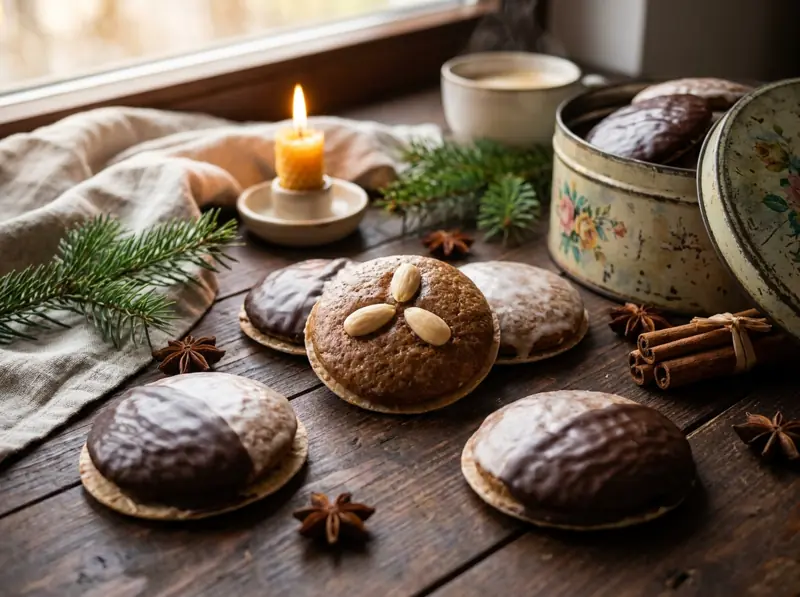
Elisenlebkuchen (Nuremberg Gingerbread Cookies on Wafers)
Elisenlebkuchen are Nuremberg's finest gingerbread, also written Elisen-Lebkuchen or simply called Nürnberger Lebkuchen when made in that city. Under German food-code standards they must be at least 25% ground almonds, hazelnuts or walnuts and no more than 10% flour, and this version leaves flour out entirely, so the whole cookie is nuts, candied citrus peel, honey and spice held together by whipped egg instead of dough. Baked on round wafers so the sticky mixture never touches the tray, they come out chewy rather than crisp, closer to a soft nut macaroon than to a firm, bready spiced biscuit. The 55 minutes cover whipping the eggs, mixing, baking two trays and glazing half in sugar icing and half in chocolate; the raw mixture also rests an hour in the fridge, and the glaze needs a night to set hard. Makes about 20 pieces, two to a serving.
Ingredients
- 120 gground almonds
- 120 gground hazelnuts
- 40 gground walnuts
- 120 gcandied orange peel
- 120 gcandied lemon peel
- 3 eggs
- 140 gbrown sugar
- 2 tbsphoney
- 2 tspgingerbread spice
- 1 tspground cinnamon
- 1 pinchsalt
- 20 baking wafers
- 100 gicing sugar
- 2 tbsplemon juice
- 100 gdark chocolate
Method
- Chop the candied orange peel and candied lemon peel as fine as you can, almost to a paste — a mini food processor does this in under a minute, or use a sharp knife and patience. Coarse pieces of peel are the main reason home-baked Elisenlebkuchen can taste patchy: a stray chunk gives one bite all the citrus and leaves the next one bland. Set the chopped peel aside; it goes in with the nuts, not with the eggs.
- In a large bowl, whisk the eggs, brown sugar and honey with a hand mixer for 5 to 6 minutes, until the mixture turns pale and triples in volume, like a loose sabayon. This whipped egg is the only thing holding Elisenlebkuchen together and giving them a little lift in the oven, since there is no flour and no raising agent anywhere in the recipe. Do not rush this step, or the cookies bake dense and flat.
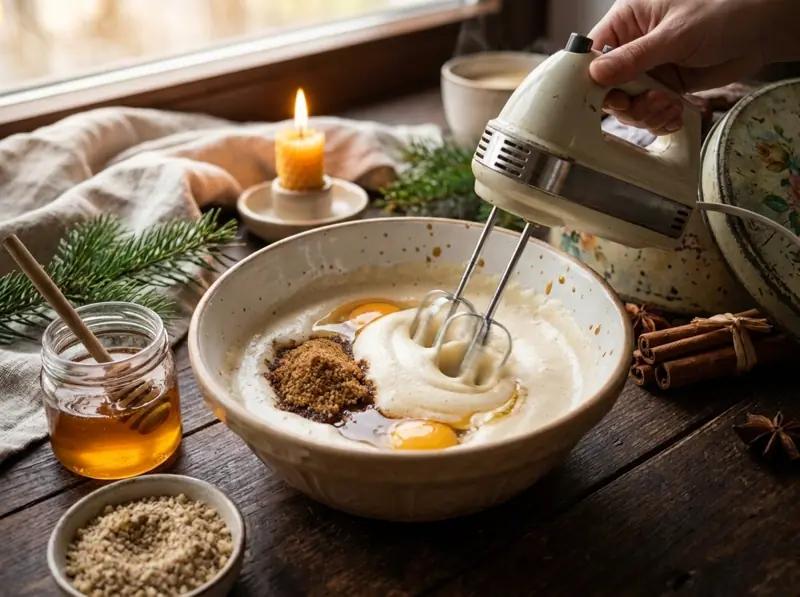
- Fold in the ground almonds, ground hazelnuts, ground walnuts, chopped candied peel, gingerbread spice, cinnamon and salt with a spatula, working from the bottom up so you do not knock the air out of the eggs. The mixture turns thick, sticky and hard to stir just before all the nuts disappear; stop as soon as no dry patches remain. It should hold a soft peak on the spatula, not run off it.
- Cover the bowl and refrigerate for 1 hour. The mixture firms up enough to portion cleanly, and the spices and citrus peel have time to spread through the whole batch instead of tasting concentrated in a few spots. If you are short on time you can skip this and bake right away, but the flavour is noticeably rounder after the rest.
- Heat the oven to 160°C top and bottom heat (140°C fan) and line two trays with baking paper. Lay out the wafers and spoon about 40 g of the chilled mixture onto each one, a heaped tablespoon or one small ice-cream scoop. Smooth it out with a wet spoon or wet fingers right to the edge of the wafer, leaving no bare rim — a rim without mixture is the main reason wafers pop off after baking, since nothing is holding them to the top. A slight dome in the centre is fine.
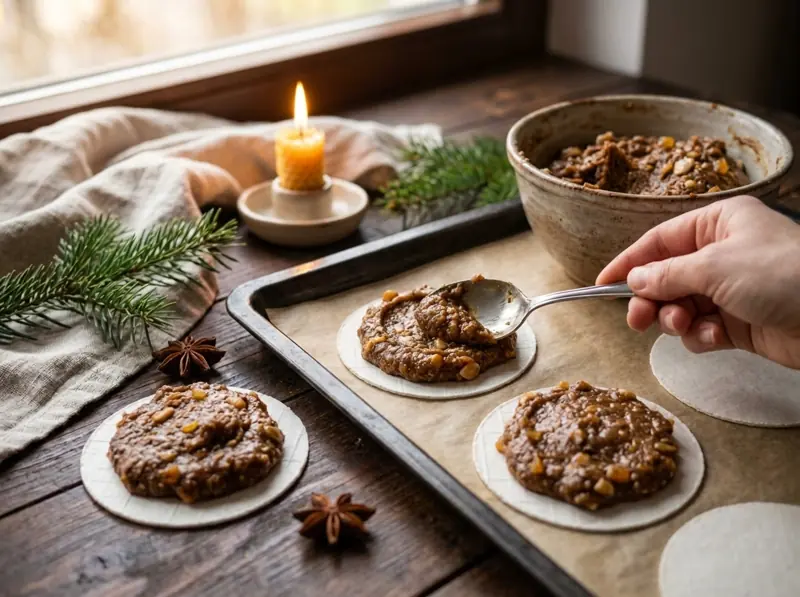
- Bake one tray at a time on the middle rack for 20 to 22 minutes. The surface should look matte and no longer wet, with barely any colour — Elisenlebkuchen are meant to stay pale and soft inside, and a deeply browned top means they have dried out. Cool completely on a rack before glazing; warm cookies melt the icing straight off.
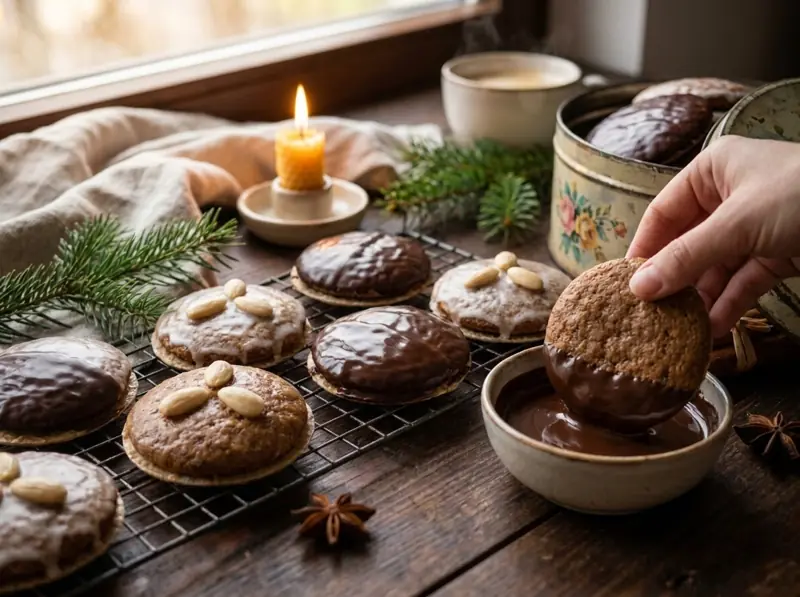
- Split the cooled cookies into two batches. Whisk the icing sugar with the lemon juice until smooth and spread it over one batch. Melt the dark chocolate in a bowl set over barely simmering water, stirring until glossy, and coat the second batch. Leave both batches on a rack, uncovered, overnight, until the icing and chocolate have set hard, and only then layer them into a tin.
FAQ
Both problems trace back to how the mixture meets the wafer. If it only covers the middle and leaves a bare rim, nothing glues the wafer to the cookie at the edges, and it pops off cleanly once cool; smooth the mixture all the way to the wafer's edge with a wet spoon before it goes in the oven. Spreading happens for the opposite reason, usually too much mixture piled high in the centre, or a batch that wasn't chilled and went in soft and runny. Stick to about 40 g per 70 mm wafer, keep the dome low, and give the mixture its hour in the fridge even when you're tempted to skip it.
You can swap in the same weight of very finely chopped dried apricots or dates, which works for bakers who dislike candied peel, though the citrus note disappears and the flavour turns more date-forward. A closer fix, if the real problem is only the artificial-tasting supermarket kind, is buying whole candied peel from an Italian or Middle Eastern grocer and chopping it yourself; the difference in taste is bigger than most people expect. Leaving it out entirely and adding 240 g more ground nuts instead also works, though the cookies lose the little bursts of chew that make Elisenlebkuchen recognisable. Whatever you use, chop it as fine as you would the peel, or it clumps the same way.
In an airtight metal tin at room temperature they keep 3 to 4 weeks, and unlike most cookies they actually improve after the first few days, once the honey and spices spread evenly through the nut base. A slice of apple, replaced every 2 to 3 days before it grows mould, genuinely helps: it releases a little moisture into the sealed tin without ever touching the cookies, which counteracts the drying effect of all that sugar. Layer baking paper between rows so the glaze doesn't stick to the cookie above it, and keep the tin away from milder cookies like Vanillekipferl, which absorb the citrus and spice fast if they share a tin. Plastic containers work in a pinch but trap less flavour and let more moisture escape than metal.
Elisenlebkuchen are the premium tier: at least 25% ground almonds, hazelnuts or walnuts, no more than 10% flour by German food-code standards, and this recipe uses none at all, so the whipped eggs alone hold it together. Braune Lebkuchen, the everyday version sold loose at Christmas markets, start from a honey-and-flour dough that's often mixed weeks ahead and left to mature before baking, which gives a firmer, more bread-like crumb. Lebkuchen cut into gingerbread-house panels or little men need that same sturdier honey dough to hold a cut edge and dry hard enough to build with; Elisenlebkuchen would collapse under their own softness. Only cookies actually baked within the city limits of Nuremberg may legally be labelled Nürnberger Lebkuchen, a protected designation since 1996, though Elisenlebkuchen made anywhere else follow the same recipe standard. Alongside Zimtsterne and gingerbread men on a German Bunter Teller, Elisenlebkuchen are easily the softest and chewiest of the three.
Lebkuchengewürz is the German gingerbread spice blend behind Elisenlebkuchen, Lebkuchen and Spekulatius alike, and every bakery mixes its own ratio. A reliable homemade version: 12 g ground cinnamon, 4 g ground cloves, 4 g ground ginger, 3 g ground allspice, 3 g ground coriander, 2 g ground nutmeg, and 1 g each of ground cardamom and ground anise, stirred together and kept in a sealed jar. That makes about 30 g, enough for roughly six batches of the 2 teaspoons this recipe needs, and it stays aromatic for up to a year away from light and heat. Ready-mixed Lebkuchengewürz from a German supermarket works just as well if you would rather not track down eight different spice jars for one recipe.
Rate this
Recipes by email
One letter a week: a recipe picked for your taste, plus whatever is new on the site. Unsubscribe in one click.
Welcome gift: Sergei's cookbook (e-book).
By subscribing you agree to the privacy policy.
Tell us what you like to cook (30 seconds) →Keep browsing
More dishes from the German archive — picked by overlap with what you're cooking now.

Join the conversation
Comments
No comments yet — be the first!