
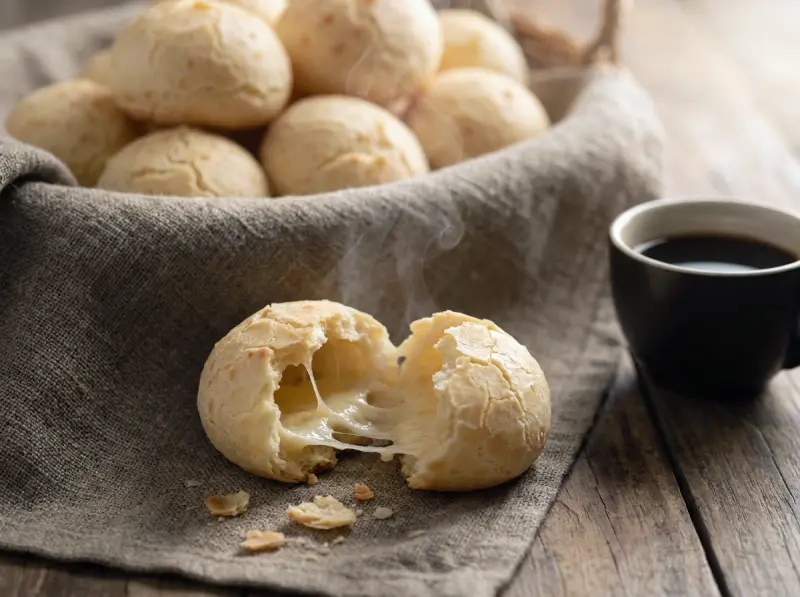
Pão de Queijo
Pão de queijo is the cheese roll of Minas Gerais: crisp and thin-shelled outside, hollow and stretchy inside, made entirely from cassava starch with no wheat anywhere in it. The texture comes from a single technique, the escaldo, in which boiling liquid is poured over the starch and gelatinises it before eggs and cheese go in. Traditional recipes use both grades of cassava starch, the sour polvilho azedo for lift and a faint tang and the sweet polvilho doce for tenderness, and the cheese is fresh cow's-milk queijo minas. It is eaten warm at breakfast with coffee, sold from insulated boxes on the street, and set out at churrasco tables while the meat cooks.
Ingredients
- 250 gsour tapioca starch
- 250 gsweet tapioca starch
- 250 mlwhole milk
- 120 mlvegetable oil
- 100 mlwater
- 3 pieceseggs
- 200 gqueijo minas
- 50 ggrated parmesan
- 1.5 tspfine sea salt
Method
- Weigh both starches into a large heatproof bowl and mix them together. Have the eggs and cheese ready at room temperature, because the dough has to be assembled in one continuous sequence once the liquid boils.
- Combine the milk, oil, water and salt in a saucepan and bring to a full rolling boil, not just to steaming. A liquid below boiling point will not gelatinise the starch, and that single failure produces flat, dense rolls no matter what happens later.
- Pour the boiling liquid over the starch all at once and stir hard with a wooden spoon for about a minute. The mass will look lumpy, stiff and unpromising, which is exactly right at this stage; a smooth batter here means the liquid was not hot enough.

- Let the mass cool 15 minutes, to below 60 °C, then beat in the eggs one at a time, working each one fully in before the next. Added too early, the eggs scramble in the hot starch and leave yellow specks.
- Work in the crumbled queijo minas and the parmesan and knead 3 to 4 minutes, by hand or with a mixer, until the dough is smooth, elastic and slightly tacky. Rest it 20 minutes so the starch hydrates evenly.

- Oil your hands and roll balls of about 30 g, spacing them 3 cm apart on a lined tray, since they nearly double in width. Bake at 200 °C for 20 to 25 minutes until puffed and pale gold, and do not open the oven during the first 15 minutes.

- Let them sit 5 minutes before eating, so the interior finishes setting into strands rather than paste. They are at their best within the hour and should be served warm rather than reheated later.
FAQ
The liquid almost certainly did not reach a true rolling boil, so the starch never gelatinised. Two other causes are an oven below 190 °C, which lets the shells set before the steam expands, and opening the door in the first 15 minutes, which collapses them mid-rise.
All sweet polvilho gives a smoother, softer roll with less lift and none of the faint sourness, while all sour polvilho gives a bigger puff and a more pronounced tang with a slightly drier crumb. Both are usable; the half-and-half blend is the Minas standard because it sits between them. Do not substitute corn starch or wheat flour, which behave nothing like this.
A mixture of low-moisture mozzarella for the stretch and a hard aged cheese such as parmesan or pecorino for the salt and flavour comes close. Avoid cheeses with a high water content, which loosen the dough and cause the rolls to spread instead of rising.
Raw rolled balls freeze for three months and are the right way to keep them. Baked ones lose their contrast within a couple of hours and go leathery in the fridge; if you must revive them, 5 minutes in a 180 °C oven works, but a microwave turns them into rubber.
Chipa, from Paraguay and Argentina, uses the same cassava starch but often adds cornmeal and anise and eats denser. Gougères are French choux with cheese and are built on wheat and a steam-raised paste, so they are airy and crisp rather than chewy. Only pão de queijo has the elastic pull that cassava starch alone gives.
Rate this
Recipes by email
One letter a week: a recipe picked for your taste, plus whatever is new on the site. Unsubscribe in one click.
Welcome gift: Sergei's cookbook (e-book).
By subscribing you agree to the privacy policy.
Tell us what you like to cook (30 seconds) →Keep browsing
More dishes from the Brazilian archive — picked by overlap with what you're cooking now.
Join the conversation
Comments
No comments yet — be the first!