


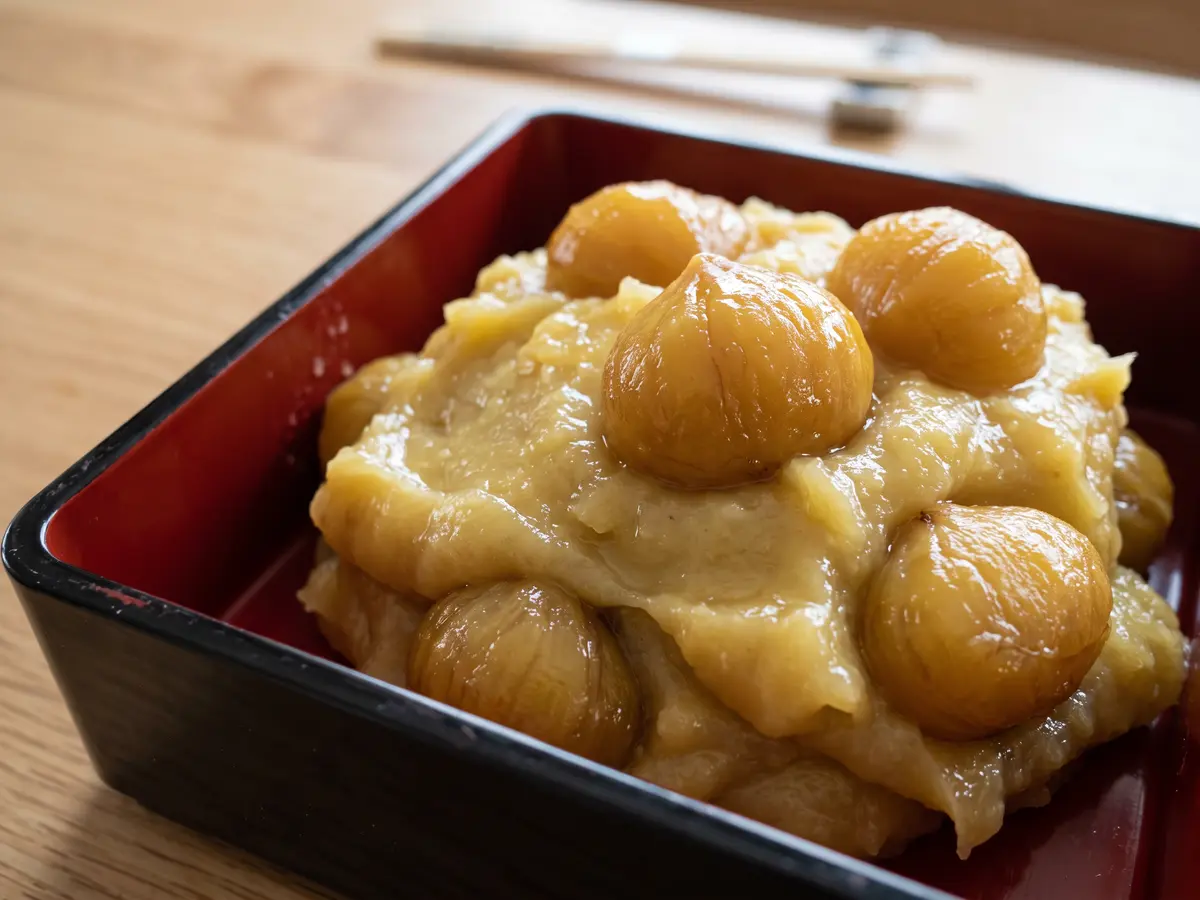
Kuri Kinton (Japanese Sweet Potato and Chestnut Mash)
Kuri kinton (栗きんとん, also written kurikinton or 栗金団) is a golden mash of Japanese sweet potato with whole chestnuts candied in syrup. It is sweet, but it is served with the other osechi dishes that Japanese families set out for the New Year as a wish for wealth. The name is written with the characters for gold and gathering, and Japan's agriculture ministry likens the potato to gold and the chestnuts to koban, old gold coins, a wish for a prosperous year. It takes about an hour, plus 15 minutes of soaking and about half an hour to cool. This version leaves out the gardenia pods that many Japanese cooks use for a brighter yellow, so the colour comes from the potato alone.
What kuri kinton is
Kuri kinton is a mash of Japanese sweet potato and candied chestnuts, cooked with sugar until it holds its shape, and it belongs to osechi, the New Year food of Japan. Japan's agriculture ministry writes kinton as 金団 and explains it as a gathering of gold, treasure. In its December 2017 issue the ministry's magazine says the potato is likened to gold and the chestnuts to koban, the gold coins of old Japan, a wish for a prosperous year. Many osechi dishes work this way, on wordplay and good omens.
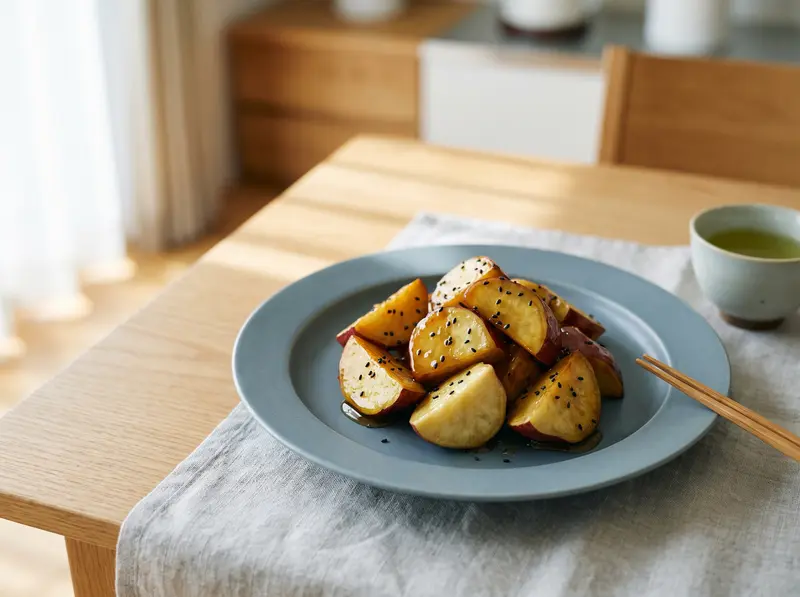
Osechi dishes are seasoned more strongly with sugar or vinegar so they keep for several days, and kuri kinton is part of that set. It is eaten in the same first days of the New Year as ozoni. Another satsumaimo sweet from the same kitchen is daigaku imo, the candied sweet potato.
Kuri kinton in Gifu is a different sweet
Search for kuri kinton in Japanese and you will also find a chestnut-shaped confection with no sweet potato in it. That is the kuri kinton of the Tōnō area of Gifu Prefecture: cooked chestnuts simmered with sugar and squeezed into a chestnut shape in a cloth. Japan's agriculture ministry says the city of Nakatsugawa is regarded as its birthplace, and people travel there for it from September into winter, when chestnuts are in season. The recipe on this page is the New Year version, made with sweet potato.
Ingredients
- 500 gsweet potato
- 2060 mlwater
- 120 gsugar
- 3 tbspmirin
- 75 mlchestnut syrup
- 120 gchestnuts in syrup
- 0.25 tspsalt
Method
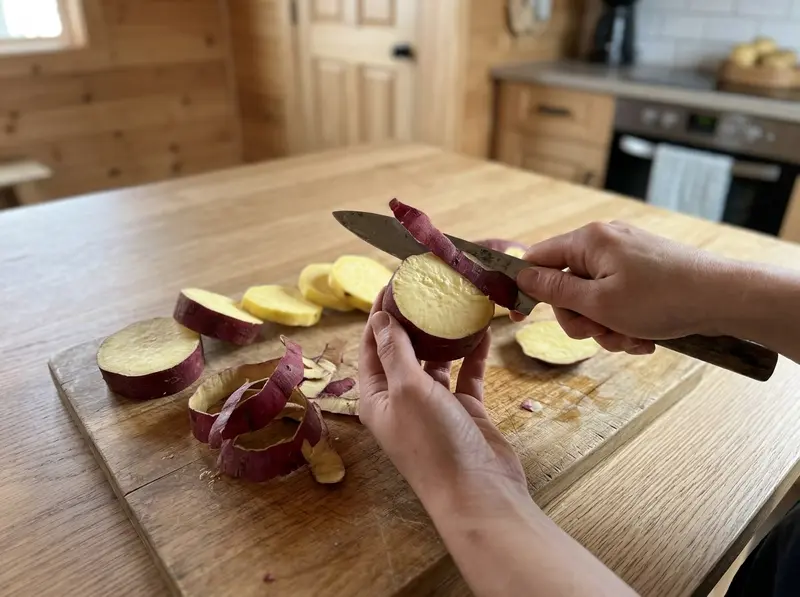
- Cut the ends off 500 g of Japanese sweet potato (satsumaimo) and slice it into 3 cm rounds. Peel each round thickly with a knife, cutting past the faint ring of fibres just inside the skin, until only clean yellow flesh is left. You should have about 400 g. A thin peel leaves those fibres in the mash and dulls the gold colour.
- Put the rounds in a bowl with 1000 ml of cold water and soak them for 15 minutes to rinse off the surface starch. Drain.
- Put the potato in a 20 cm saucepan with 1000 ml of fresh water, enough to cover it. Bring to a boil over medium heat, about 8 minutes, then turn the heat down to medium-low and simmer for 15–20 minutes, until a skewer slides into the thickest piece with no resistance. Drain in a colander.
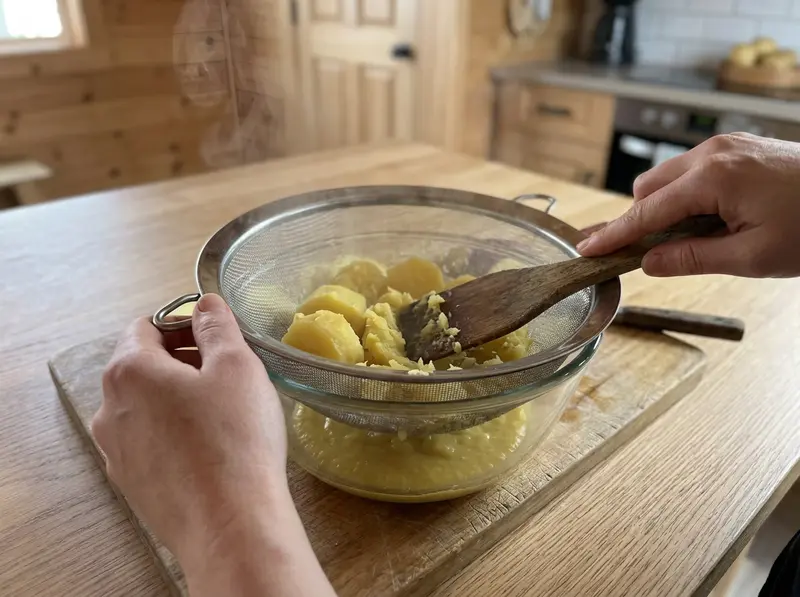
- While the potato is still hot, press it through a fine-mesh sieve set over a bowl, a few pieces at a time, pushing down with a wooden spatula and drawing it toward you. Scrape off the purée that clings to the underside of the sieve and throw away the fibres left inside. Do it hot: starchy potato turns sticky and hard to press as it cools, and the sieve is what makes the mash smooth.
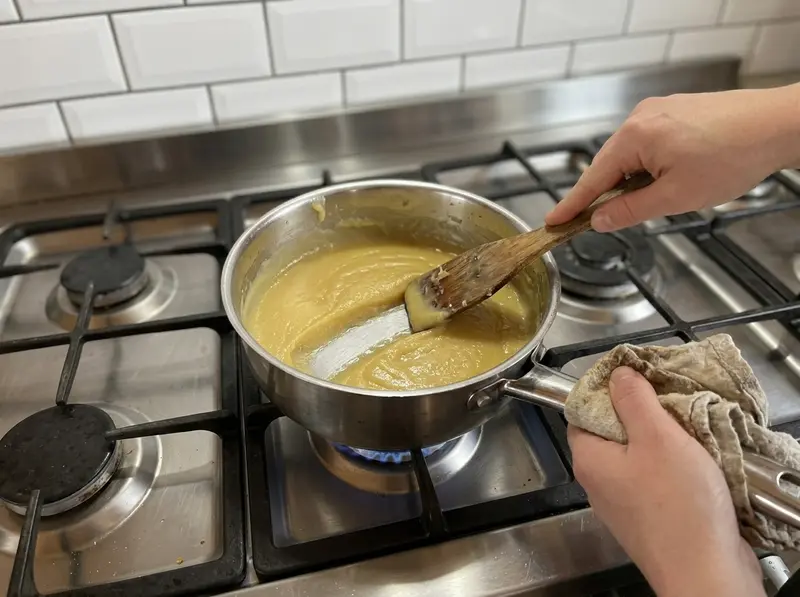
- Rinse the saucepan and put the purée back in. Add 120 g of sugar and mix it in well before any liquid goes in, so it does not form lumps. Stir in 3 tbsp of mirin, 45 ml of the chestnut syrup and ¼ tsp of salt, then 60 ml of water. Meanwhile, put 120 g of chestnuts in syrup (about 12) and the remaining 30 ml of syrup in a small saucepan and warm them on the lowest heat for 3–4 minutes, until the chestnuts are warm in the middle. Then take the small pan off the heat, so the thin layer of syrup does not boil away. Cook the paste over low-medium heat, stirring all the time and scraping the bottom and sides, for 8–10 minutes once it starts to bubble. It is ready when a line drawn across the bottom with the spatula stays open, the paste is glossy, and the boozy smell of the mirin has gone. The bottom catches easily, so keep the spatula moving. Take it off while it is still slightly soft, because it firms up as it cools.
- Drain the warm chestnuts and keep the syrup. Fold the chestnuts into the paste whole. Taste, and if you want it sweeter, stir in a little of the syrup you kept. Then cook on low heat for 1–2 minutes more, stirring gently so the chestnuts stay in one piece.
- Spread the kuri kinton on a shallow tray to cool quickly, which keeps the surface glossy, about 30 minutes. Serve it at room temperature. Put leftovers in an airtight container and into the fridge within 2 hours, and eat them within 3–4 days.
Cooked it? Rate the recipe
FAQ
Kuri kinton is mashed Japanese sweet potato cooked with sugar and folded with chestnuts candied in syrup. It is one of the osechi dishes, the food Japanese families prepare for the first days of January. Kinton is written 金団, which Japan's agriculture ministry explains as a gathering of gold, or treasure, and its golden colour is taken as a wish for luck with money. A ministry magazine adds that the potato stands for gold and the chestnuts for koban, old gold coins. It is sweet, but it is served with the other osechi dishes.
Japanese cooks add 1–2 dried gardenia pods (kuchinashi no mi) to the water when they boil the sweet potato. Crack the pods with pliers, kitchen scissors or a rolling pin, wrap them in cheesecloth or a tea bag, and lift them out before you drain the potato. They are there for colour. Without them, kuri kinton comes out a softer, paler gold, which is how this recipe makes it, and Shirogohan.com treats them as optional.
Better not. Just One Cookbook asks for Japanese sweet potatoes (satsumaimo) only, because they are starchy and very sweet, and says they now turn up in ordinary US grocery stores. Kuri no kanroni are peeled chestnuts cooked and kept in heavy syrup, the same chestnuts used in Japanese sweets. One jar of about 300 g, chestnuts and syrup together, is enough for this recipe: 120 g of chestnuts (about 12) and 75 ml of syrup. Making them at home starts with peeling raw chestnuts, which alone takes hours. If you have fresh chestnuts, they are better spent on kuri gohan, chestnut rice.
Yes. Just One Cookbook says a food processor works for the purée. If it is too stiff to blend, loosen it with a spoonful of the 60 ml of water from step 5. Shirogohan.com goes further: peel the potato very thickly and you can skip the sieve and use a potato masher. Either way the mash is less silky, because the sieve is what catches the fibres. If you skip it, be generous with the peel in step 1.
Just One Cookbook makes it 2 days before the New Year meal. Once it has cooled, put it in an airtight container and into the fridge within 2 hours, and it keeps 3–4 days. Take it out a while before serving, because it is eaten at room temperature. It is eaten in the same first days of the New Year as ozoni, the mochi soup.
Keep browsing
More dishes from the Japanese archive — picked by overlap with what you're cooking now.

Recipes by email
One letter a week: a recipe picked for your taste, plus whatever is new on the site. You can stop the letters in one click.
Welcome gift: Sergei's cookbook (e-book).
By signing up for the newsletter you agree to the privacy policy.
Tell us what you like to cook (30 seconds) →
Join the conversation
Comments (1)
Первый раз попробовал в 2005 году