


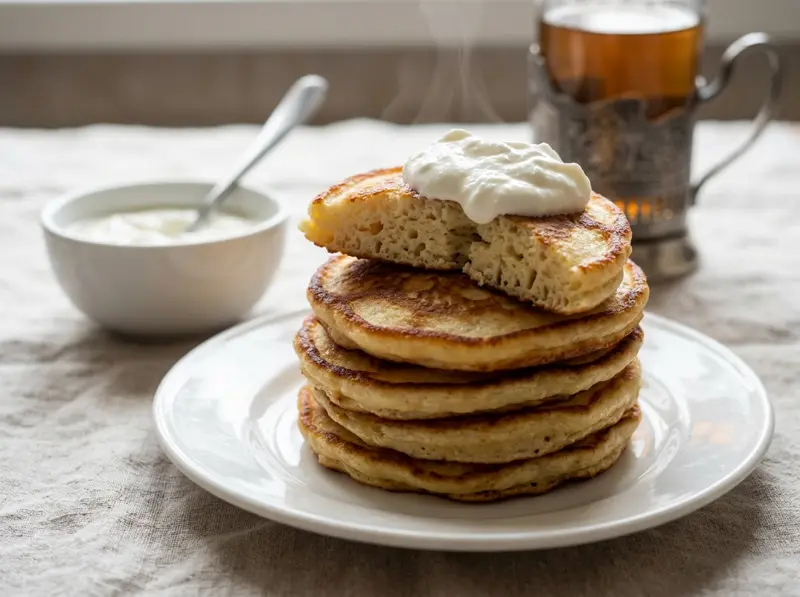
Oladyi with Kefir (Russian Kefir Pancakes, No Yeast)
Oladyi with kefir are small, thick Russian pancakes made from a heavy batter of kefir, eggs and wheat flour, raised with baking soda instead of yeast and fried in a little oil. In Russian they are оладьи (also spelled oladi) or oladushki. The German recipe site Gutekueche calls them Oladuschki, and in Japanese they are オラディ. The older, slower way raises oladyi with yeast, and that version on this site rises on warm milk for 75 to 90 minutes. This is the quick one, where sour kefir and baking soda do the work of the yeast. The batter is far thicker than for ordinary pancakes, so the oladyi stand tall and stay soft inside. Allow about 50 minutes in all, 15 of them for the batter to rest untouched.
What oladyi with kefir are
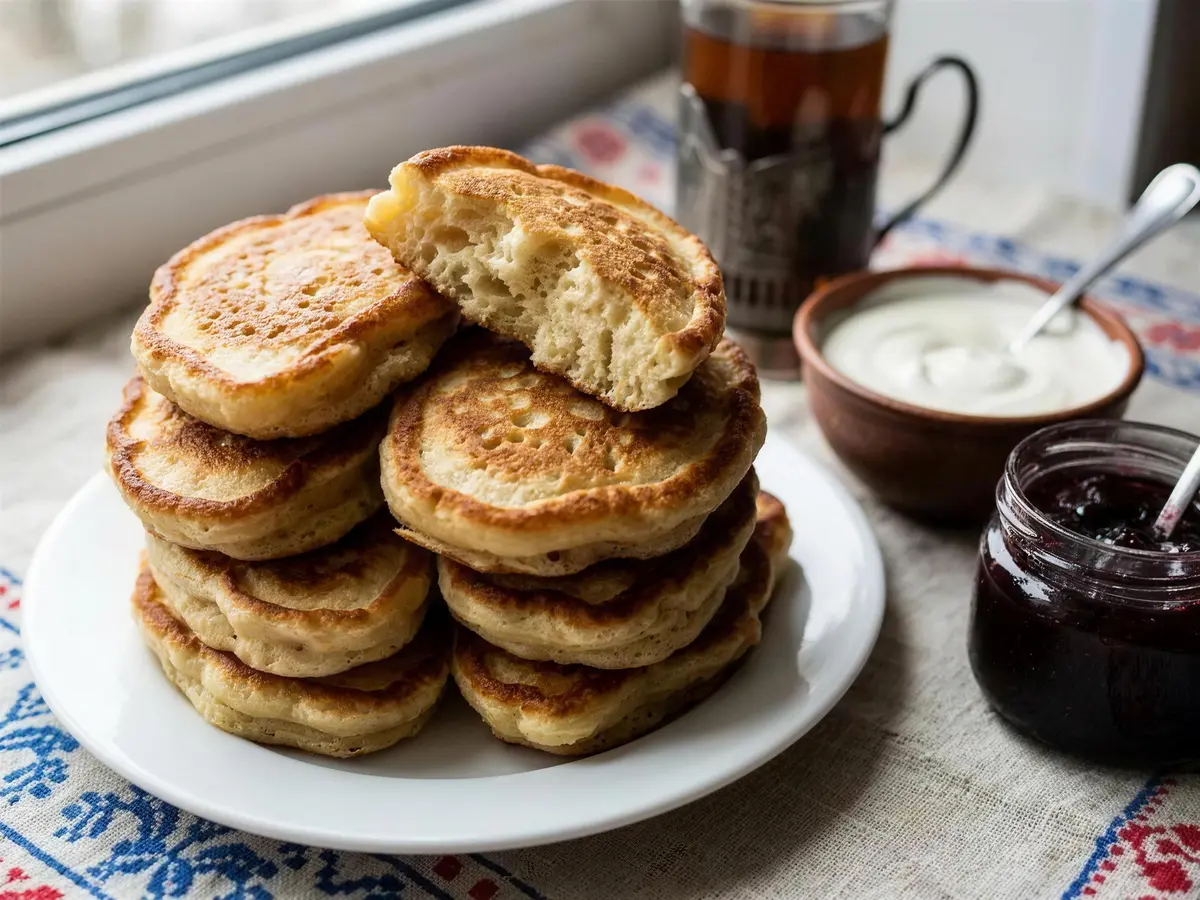
Oladyi (оладьи, also spelled oladi, or oladushki) are small Russian pancakes, thick and soft, made from a batter much heavier than for ordinary pancakes and fried in a little oil. The German site Gutekueche calls them Oladuschki, and in Japanese they are オラディ. They are eaten warm, usually with sour cream, jam or honey.
The older way raises them with yeast, and that version is on this site as yeast oladyi. This quicker version uses kefir and baking soda and takes about 50 minutes instead of 75 to 90.
Why kefir oladyi stay tall
Kefir is sour, and baking soda reacts with an acid the moment the two meet, so the batter starts making gas as soon as the flour and soda go in. During the 15-minute rest you can watch small bubbles come up to the surface. That gas is what lifts the oladyi in the pan.
The heat matters just as much. On medium heat the oladyi fry for 2 to 3 minutes on the first side, the bubbles on top burst and stay open, and after turning they puff up. On high heat the outside browns before the middle has cooked, and the oladyi come out raw and heavy inside.
Ingredients
- 500 mlkefir
- 2 eggs
- 25 gsugar
- 0.5 tspsalt
- 360 gwheat flour
- 0.5 tspbaking soda
- 75 mlvegetable oil
- 150 gsour cream
Method
- Pour 500 ml of kefir (2.5% fat) into a small saucepan (about 1 litre) and warm it over low heat for about 2 minutes, stirring. Stop when it no longer feels cold and is just lukewarm to your finger. A little whey may separate, but you should see no white flakes, because flakes mean the kefir has started to curdle. Warm kefir reacts better with the soda than kefir straight from the fridge.
- In a large bowl (about 3 litres), whisk 2 eggs with 25 g of sugar and 0.5 tsp of salt by hand until the sugar has dissolved and there are no grains left on the whisk. Pour in the warm kefir and whisk again until the mixture is even and a little foamy. A hand whisk is enough here. You don't need a mixer.
- In a second bowl, whisk 360 g of wheat flour with 0.5 tsp of baking soda so the soda is spread evenly through the flour. Tip the flour into the kefir in 3 parts, stirring after each one, first with the whisk and then with a spoon once the batter gets heavy. Stop as soon as there is no dry flour and no lumps. The batter should look like very thick sour cream and fall off the spoon slowly, in one heavy lump. A thinner batter spreads out in the pan, and a stiffer one fries up dry. There is no vinegar in this recipe, since the kefir is the acid the soda needs.
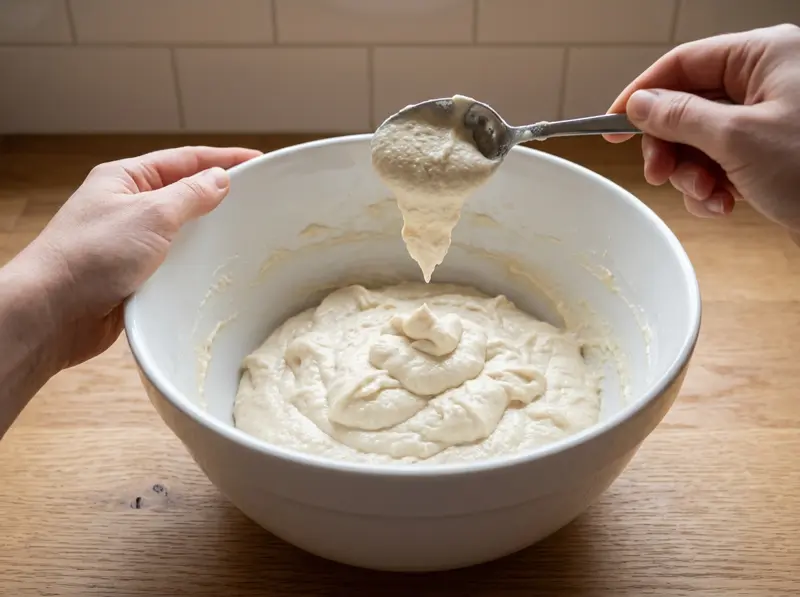
- Cover the bowl and leave it at room temperature for 15 minutes. From now on, do not stir the batter. Small bubbles will appear on the surface, which tells you the soda is reacting with the kefir. Stirring now would knock those bubbles out, and the oladyi would come out flat.
- Set a heavy 26 cm non-stick frying pan over medium heat with 1 tbsp of the vegetable oil and let it heat for 2 minutes. It is ready when the oil shimmers and a drop of batter sizzles the moment it lands. Take 2 heaped tablespoons of batter (about 50 g) from the edge of the bowl, without disturbing the rest, and drop it into the pan. Make 4 rounds per batch and leave room between them, because each one spreads to about 8 cm.
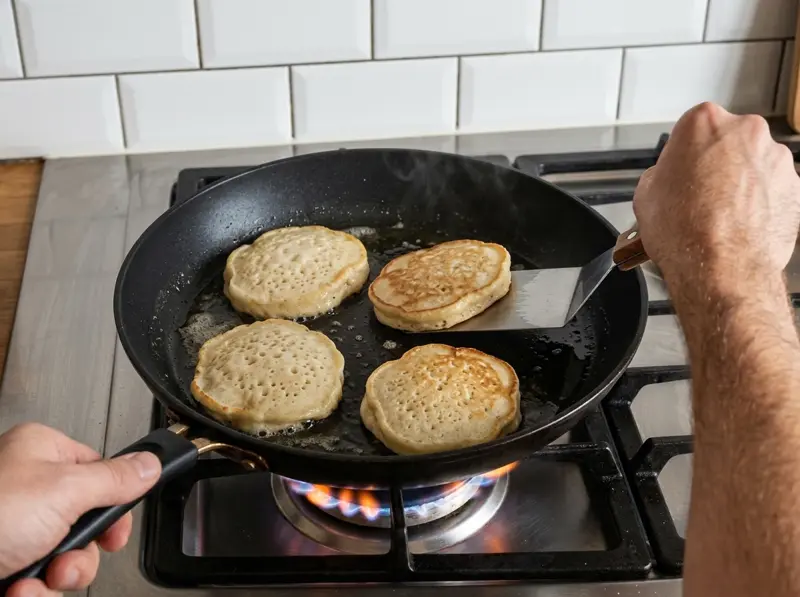
- Fry for 2 to 3 minutes, until the bubbles on top burst and stay open, the edges look matt and the underside is deep golden. Turn the oladyi with a wide spatula and fry for 2 to 3 minutes more. They puff up right after turning. Break the first one open, or push a wooden skewer into the middle: it should come out dry. The crumb should be dry and full of small holes, with no wet, glossy streak in the middle. If it is still raw inside, turn the heat down a little rather than frying longer, because a hot pan browns the outside before the egg batter in the middle has cooked.
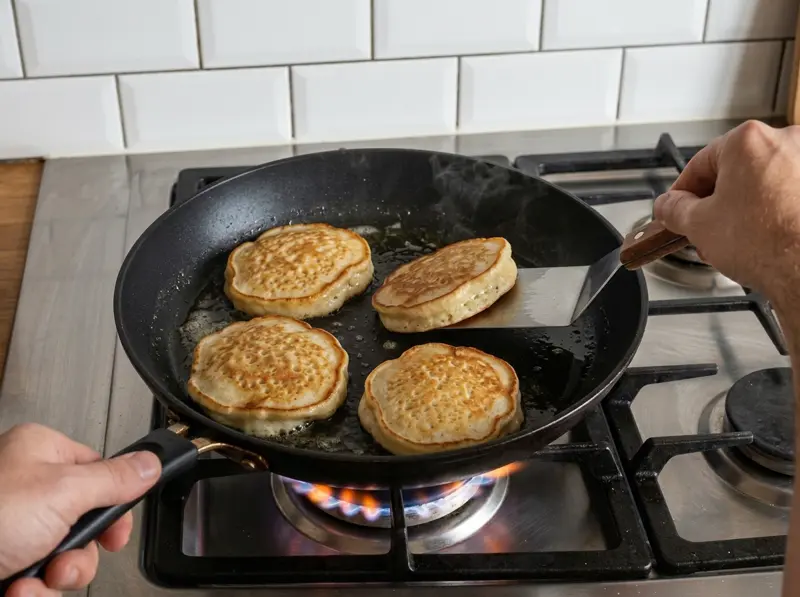
- Lift the oladyi onto a plate lined with paper towels, which takes off the extra oil. Add 1 tbsp of oil to the pan before each new batch. The batter makes 5 batches, 20 oladyi in all. Serve them hot with 150 g of sour cream.
Cooked it? Rate the recipe
FAQ
Check two things first: whether the batter was stirred after it rested, and whether it was too thin. Mix 360 g of flour into 500 ml of kefir and 2 eggs until the batter falls off the spoon in one heavy lump, then leave it for 15 minutes and don't stir it again. Take each spoonful from the edge of the bowl so the rest of the batter stays undisturbed. Fry on medium heat, 2 to 3 minutes on the first side, because on high heat the outside browns while the middle stays raw and heavy. And use kefir, not milk, because milk has no acid for the soda to react with.
No. Kefir is sour, and baking soda reacts as soon as it touches an acidic ingredient such as kefir or buttermilk, so the gas forms right in the batter. Whisk 0.5 tsp of soda into the 360 g of flour so it spreads evenly and you never bite into a pocket of it. That amount is for 500 ml of kefir, the low end of what Russian recipes use, and it's low on purpose. Even at this amount a few cooks on Povarenok say they can taste the soda, and more of it makes oladyi bitter.
Buttermilk is the closest swap, in the same 500 ml, because it is sour like kefir. Ayran, ryazhenka or prostokvasha also work. Plain milk does not. Baking soda needs an acid, milk has none, and the oladyi stay flat. Keep the amounts as they are, 360 g of flour and 0.5 tsp of soda, and check the batter by the spoon, since these drinks are not all equally thick. If it runs off the spoon in a ribbon, stir in more flour a spoonful at a time. If it stands up stiff, loosen it with a spoonful of the same drink.
Both kinds are oladyi: small, thick pancakes made from a heavy batter. The yeast oladyi on this site start with a yeast sponge on warm milk, take 75 to 90 minutes and get an open crumb with a faint sourness. Kefir oladyi are raised with baking soda, so the batter only rests for 15 minutes, and the tang comes from the kefir. Thin Russian pancakes like blinchiki are another thing altogether. Their batter is pourable and spread over the whole pan.
Serve them hot from the pan with sour cream. Jam, honey and fresh berries are the other usual toppings. While you fry the 5 batches, keep the finished ones in the oven at 80 °C so they all reach the table at once. They are best on the day you make them, since they turn tough by the next day. Put leftovers in the fridge within 2 hours and warm them in a dry pan over low heat, covered with a lid and turned once, until they are hot right through to the middle.
Keep browsing
More dishes from the Russian archive — picked by overlap with what you're cooking now.





Recipes by email
One letter a week: a recipe picked for your taste, plus whatever is new on the site. You can stop the letters in one click.
Welcome gift: Sergei's cookbook (e-book).
By signing up for the newsletter you agree to the privacy policy.
Tell us what you like to cook (30 seconds) →
Join the conversation
Comments
No comments yet — be the first!