
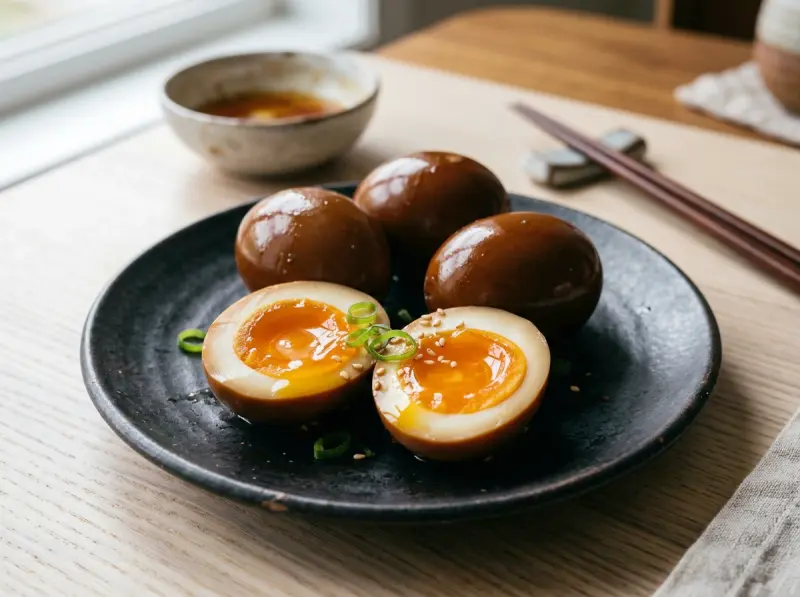
Ajitama (Japanese Ramen Eggs)
Ajitama, short for ajitsuke tamago (味玉, 味付け玉子) and also called nitamago or simply ramen eggs, are Japanese soft-boiled eggs marinated in soy sauce and mirin until the whites turn light brown and savoury-sweet while the yolks stay jammy. In Japan they are the standard topping on a bowl of ramen. The eggs boil for 6 minutes 30 seconds, go straight into ice water, then get peeled and left in a cold marinade of soy sauce, mirin, water and a splash of sake. Hands-on work takes about 20 minutes. After that the eggs sit in the fridge for 4 to 12 hours and the marinade does the rest.
Ingredients
- 6 pcseggs
- 60 mlsoy sauce
- 60 mlmirin
- 60 mlwater
- 15 mlsake
- 4 gsugar
- 500 gice
Method
- Take the eggs out of the fridge 20 minutes early so they're closer to room temperature, which helps them cook evenly and crack less. Set up a bowl of ice water before you do anything else — you'll need it the instant the timer goes.
- Bring a pot of water to a rolling boil. Lower the eggs in gently on a spoon and set a timer for exactly 6 minutes 30 seconds. Keep the water at a steady, lively boil the whole time.
- For the first minute or two, stir the eggs slowly with the spoon. This centres the yolks so they sit in the middle of the white rather than sliding to one side, which matters if you care how the cut halves look.
- The second the timer goes off, lift the eggs straight into the ice water. This stops the cooking dead — leave them a couple of minutes longer in the pot and the jammy yolk sets hard. Chill them for at least 5 minutes.
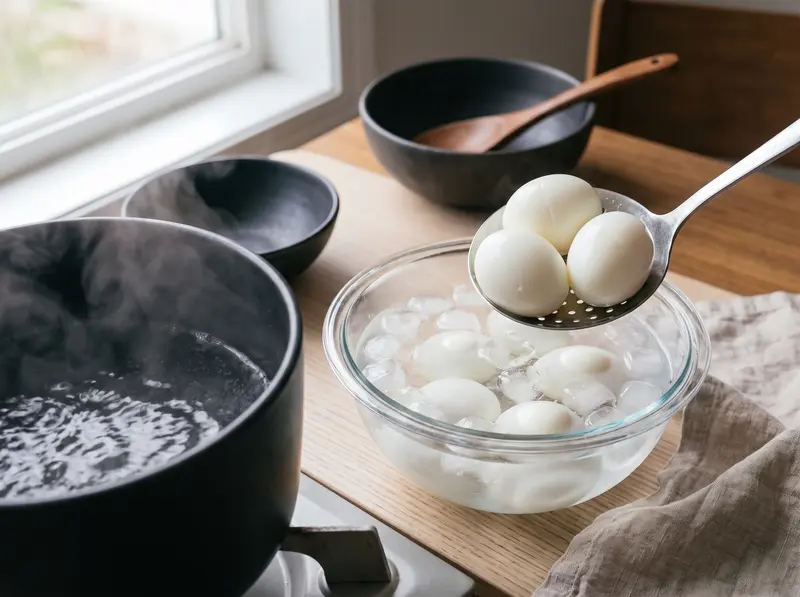
- Peel the eggs under a thin run of cold water, starting from the wide base where the air pocket is. Fresh eggs peel worse than slightly older ones, so if you can plan ahead, week-old eggs are easier here.
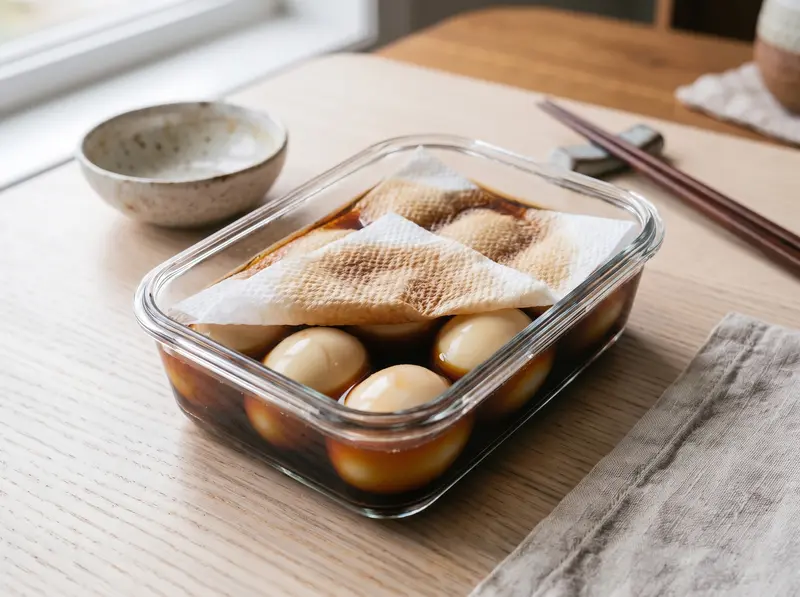
- Make the marinade by warming the soy sauce, mirin, sake, and water with the sugar just until the sugar dissolves, then let it cool completely. Warm marinade poured over the eggs would keep cooking the whites.
- Put the peeled eggs in a small container or a zip bag so the marinade surrounds them, and refrigerate for 4 to 12 hours. Longer isn't better here: past a day the whites turn rubbery and over-salty. Halve and serve on ramen, rice, or on their own.
FAQ
Ajitama is the short form of ajitsuke tamago, which means "seasoned egg": a soft-boiled egg that is peeled and marinated in soy sauce and mirin. Nitamago (煮玉子, "simmered egg") is another name you will see on ramen menus, and in practice it means the same marinated egg. The white turns light brown and savoury-sweet, and the yolk stays thick and jammy. A bowl of ramen usually gets one egg cut in half.
Eggs of about 60 g that have been out of the fridge for 20 minutes need 6 minutes 30 seconds in rapidly boiling water. That gives a set white and a thick, jammy yolk. Eggs straight from the fridge need closer to 7 minutes, and at 6 minutes the centre is still runny. Move them into ice water the moment the timer goes off, or the heat left inside keeps cooking the yolk. Turning the eggs gently for the first 2 minutes keeps the yolk in the middle, so the halves look neat.
Saltiness is a matter of time: as long as the egg sits in the marinade, the soy sauce keeps working its way in. In a marinade of equal parts soy sauce, mirin and water, 4 hours seasons the white and 8 to 12 hours takes the flavour to the edge of the yolk. After 12 to 24 hours the white goes firm and salty, so lift the eggs out and store them without the marinade. Eggs that already taste too salty are fine over plain rice or in an unsalted broth, where the seasoning evens out.
Yes. Regular soy sauce is brewed with wheat, so for a gluten-free version use tamari labelled gluten-free and check the mirin label too. Mirin can be replaced with sake and sugar in a 3:1 ratio, or with water and sugar in the same 3:1 ratio if you want to avoid alcohol. The 15 ml of sake in this recipe is optional, and the eggs turn out fine without it.
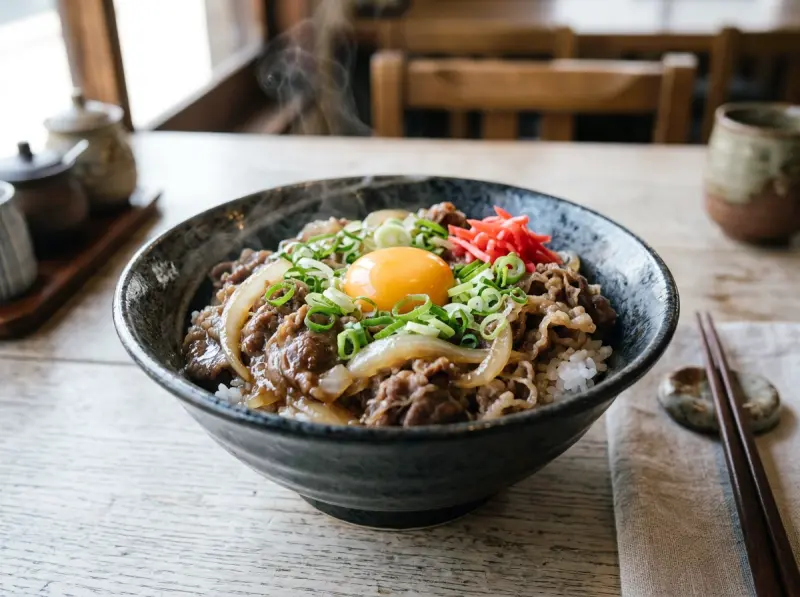
Once lifted out of the marinade, soft-boiled ajitama keep for 3 to 4 days in a closed container in the fridge. Do not leave them at room temperature for more than 2 hours. Besides ramen, half an egg is good on gyudon or a plain bowl of rice, and it packs well next to onigiri for lunch. Cut them just before serving so the yolk does not dry out.
Rate this
Keep browsing
More dishes from the Japanese archive — picked by overlap with what you're cooking now.

Join the conversation
Comments
No comments yet — be the first!