


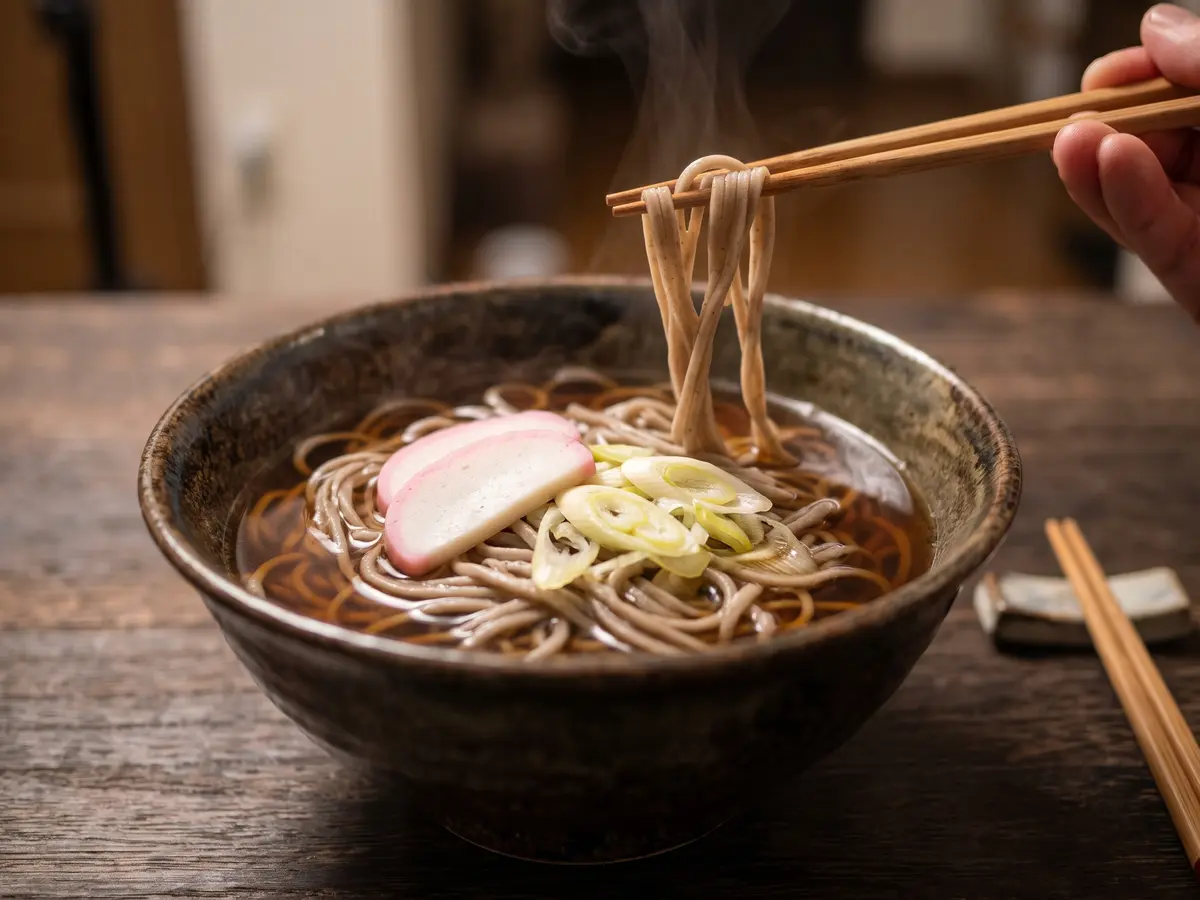
Toshikoshi Soba (Japanese New Year's Eve Noodles)
Toshikoshi soba (年越しそば, "year-crossing soba") is the bowl of buckwheat noodles Japanese families eat on New Year's Eve, 31 December, before the new year begins. Japan's agriculture ministry says the long, thin noodles stand for a long life, and because soba snaps more easily than other noodles, eating it is meant to cut away the hardships of the old year. Any soba noodle soup will do. This is kake soba, the plainest version: dried soba in a hot broth of kombu and bonito dashi with soy sauce and mirin, topped with negi simmered in the broth and slices of kamaboko fish cake. The noodles are rinsed in cold water, which keeps the broth clear, and warmed again just before serving. It takes about 35 minutes, dashi included.
What toshikoshi soba is
Toshikoshi means crossing over into the new year, and toshikoshi soba is the soba eaten on the last night of the old one. Japan's agriculture ministry (MAFF) says the habit began in the Edo period as one of the celebration dishes of New Year's Eve, and that more than 60 % of households reportedly keep it today. In the ministry's telling, the long noodles stand for a long life, and since soba breaks more easily than other noodles, it also cuts off the troubles of the year.
There is no single recipe. Just One Cookbook says any soba noodle soup will do. This one is kake soba, the plainest kind: noodles in hot broth with negi and kamaboko. Several of the Japanese recipes behind it finish with a pinch of shichimi togarashi at the table for anyone who wants some heat. For another winter bowl with negi, try tonjiru, the Japanese pork and vegetable soup.
Toshikoshi soba toppings: shrimp tempura and herring soba
Shrimp tempura on top turns the bowl into tempura soba. Mizkan's toshikoshi soba uses ready-made shrimp tempura from the shop, two pieces per person, set on the noodles once the broth is in. Kikkoman suggests shrimp, kabocha or maitake tempura on top, if you like.
Herring soba (nishin soba) is sweet-simmered dried herring on hot soba. MAFF says Kyoto's is the famous one, with a light broth of kombu and light soy sauce, while Hokkaido's uses dark soy sauce and tastes slightly sweet. The dish is said to have started in Kyoto.
Toshikoshi soba and buckwheat allergy
Buckwheat is one of the foods Japan requires on allergen labels, and reactions to it can be severe. Japan's Food Safety Commission notes that the allergen dissolves into cooking water and survives boiling, so even udon boiled in soba water has made allergic people ill. If anyone at your New Year's Eve table is allergic, cook their food separately in clean pots, and use the soba water for soba alone.
Ingredients
- 5200 mlwater
- 10 gkombu
- 20 gbonito flakes
- 80 gkamaboko
- 100 gnegi
- 100 mlsoy sauce
- 100 mlmirin
- 360 gsoba noodles
Method
- Pour 4000 ml of the water into your largest pot, one that holds about 6 litres, cover it and set it over high heat. That much water takes a while to boil, so it goes on first and heats while you make the dashi and the broth.
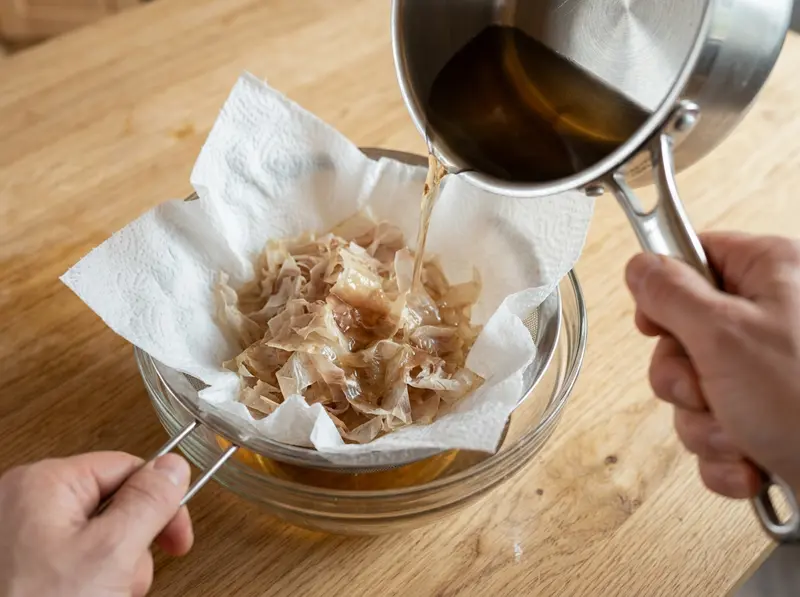
- Put the 10 g of kombu and the remaining 1200 ml of cold water in a 20 cm saucepan and heat it slowly on medium-low, about 10 minutes. Slow heating draws the flavour out of the kelp. When small bubbles start rising from the bottom of the pan, just before it boils, lift the kombu out. Bring the water to the boil, add the 20 g of bonito flakes and turn the heat down to low, so the flakes only just move about in the water, for 4 to 5 minutes. Line a fine sieve with a paper towel, set it over a large bowl and pour the dashi through. Don't press the flakes, because squeezing them adds off flavours. You should have about 1 litre of clear amber dashi.
- While the dashi simmers, prepare the toppings. Slide a knife under the 80 g of kamaboko to free it from its little wooden board and cut it into 8 slices. Cut the 100 g of negi in half lengthwise, then on the diagonal into pieces 5 to 6 mm wide. Cut like this, the negi keeps a little bite and clings to the noodles.
- Rinse the saucepan, pour the dashi back in and add the 100 ml of soy sauce and the 100 ml of mirin. Heat it on medium. When it starts to bubble, add all the negi. Once it boils again, turn the heat to low and let it bubble gently for 1 to 2 minutes, which also cooks off the alcohol in the mirin. The negi should be soft and still bright. Turn off the heat. The broth is made before the noodles because soba cooks fast and shouldn't sit around waiting for it.
- Check that the big pot is at a full rolling boil. Add the 360 g of dried soba noodles, spreading them out as they go in, and loosen them straight away with long chopsticks so they don't clump. Don't salt the water. Keep it boiling for the time printed on the package. If the package gives a separate time for hot soba, use that one. If the water foams up towards the rim, turn the heat down a little instead of adding cold water, so the temperature stays steady. When the time is up, bite a strand: it should be cooked through, with no hard white core.
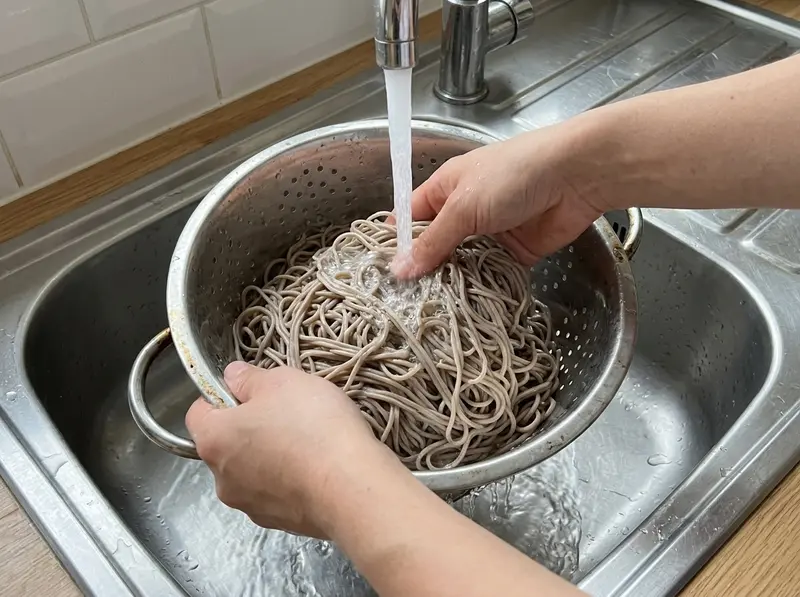
- Lift the noodles out with a large mesh strainer into a colander, and leave the pot of water on high heat with the lid on. Rinse the noodles under cold running water, rubbing them gently with your hands until they no longer feel slippery, then drain them well. Rinsing washes off the surface starch, so the broth stays clear and the strands don't stick together.
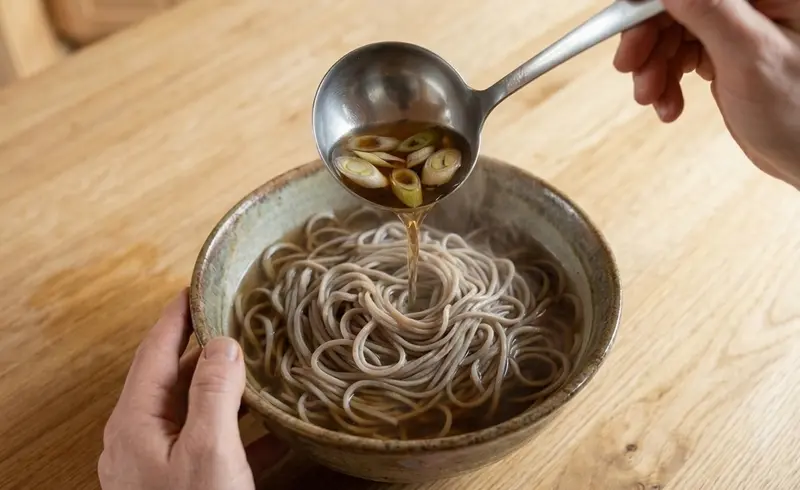
- Bring the broth back to the boil. Put a quarter of the noodles in the mesh strainer, dip them into the boiling noodle water for a few seconds until they are hot again, shake off the water and tip them into a large noodle bowl. Do the same with the rest. Pour about 300 ml of hot broth with its negi over each bowl, loosen the noodles at once with chopsticks so they don't stick together, lay 2 slices of kamaboko on top and serve straight away. Afterwards, pour the noodle water away. Buckwheat allergen dissolves into the water and survives boiling, so never cook udon or anything else in it for someone with a buckwheat allergy.
Cooked it? Rate the recipe
FAQ
Toshikoshi soba (年越しそば) is soba eaten on Ōmisoka, New Year's Eve, 31 December. It is a custom rather than one fixed recipe: any soba noodle soup counts, and Japanese recipe pages, Kikkoman's and Shirogohan.com among them, publish plain kake soba, hot soba in broth, for the night. Japan's agriculture ministry, MAFF, says there is no set time to eat it, so dinner or just before midnight are both fine, as long as you finish before the year changes. The next morning, New Year's Day starts with ozoni, the mochi soup.
According to MAFF, Japan's agriculture ministry, the custom began in the Edo period, when soba was reportedly one of the celebration dishes on the last night of the year. Today people eat the long, thin noodles as a wish for a long life, the ministry says, and because soba breaks more easily than other noodles, it also stands for cutting off the hardships and bad luck of the old year. By MAFF's account, more than 60 % of Japanese households eat it on New Year's Eve. Just One Cookbook reads the noodles as a sign of strength, endurance and long life.
Usually it is not. Juwari soba is made from 100 % buckwheat flour, while nihachi soba is 8 parts buckwheat flour to 2 parts wheat flour, according to Japan's federation of soba restaurants. Most dried soba is not juwari: Japan's National Consumer Affairs Center explained in 2017 that a dried soba package with no ratio printed on it contains at least 30 % buckwheat flour, and the usual binder is wheat flour, as in nihachi soba. Ordinary soy sauce is brewed from soy and wheat as well. For a gluten-free bowl you need noodles labelled 100 % buckwheat and gluten-free, plus 100 ml of wheat-free tamari in place of the soy sauce. Check every label, and read the kamaboko's too.
No. Japan's Food Safety Commission says buckwheat allergy often brings severe breathing symptoms, and deaths have been reported. Even trace amounts can set off a serious reaction. The allergen dissolves in water and isn't destroyed by heat, so udon boiled in water that was used for soba has caused reactions, and buckwheat flour dust can bring on asthma-like symptoms. For an allergic guest, make something without buckwheat, such as udon noodle soup, in fresh water, with a pot, strainer and chopsticks that haven't touched the soba. Japan and Korea require buckwheat on allergen labels, but Europe and the US don't, so read the ingredient list of anything you buy there.
Yes to both. Make the broth and cut the toppings ahead, get the cooled broth into the fridge within 2 hours, and keep it apart from the noodles for up to 2 days. Bring it back to a full boil before serving, which takes it past 74 °C, and boil the noodles fresh, because they taste best straight from the pot. With bottled mentsuyu, dilute it the way the bottle says for hot noodles and make about 1.2 litres for 4 bowls. Mizkan's toshikoshi soba, for example, uses 150 ml of its double-strength tsuyu to 450 ml of water for 2 bowls, so double that. Kikkoman mixes 80 ml of its concentrated tsuyu with 600 ml of water and calls it an easy amount to make. Simmer the negi in it for 1 to 2 minutes, as in step 4.
Keep browsing
More dishes from the Japanese archive — picked by overlap with what you're cooking now.




Recipes by email
One letter a week: a recipe picked for your taste, plus whatever is new on the site. You can stop the letters in one click.
Welcome gift: Sergei's cookbook (e-book).
By signing up for the newsletter you agree to the privacy policy.
Tell us what you like to cook (30 seconds) →
Join the conversation
Comments (1)
О! Это очень вкусно! Не ожидал