

Kartoffelsuppe (German Potato Soup)
Kartoffelsuppe is the everyday German potato soup: floury potatoes cooked down with Suppengrün, the standard bundle of carrot, celery root, leek and parsley sold in every German supermarket, and seasoned with marjoram rather than thyme. Sliced Bockwurst or Wiener sausages go in at the end. The potatoes do the thickening themselves, so there is no flour and no roux; mashing a third of them against the pot gives a body that flour would only make pasty. Thuringia blends the whole pot smooth, Saxony leaves the cubes whole, and this version sits between the two.
Ingredients
- 800 gpotato, floury (Bintje, Adretta, King Edward)
- 150 gcarrot
- 100 gcelery root
- 150 gleek
- 1 onion
- 2 clovesgarlic
- 80 gsmoked streaky bacon
- 20 gbutter
- 1200 mlvegetable broth
- 1 bay leaf
- 2 tspdried marjoram
- 250 gsausage, Bockwurst or Wiener
- 100 mlheavy cream
- 1 tspwhite wine vinegar
- 1 pinchnutmeg
- 1 tspsalt
- 15 gflat-leaf parsley
- ½ tspblack pepper
Method
- Peel the potatoes and cut them into cubes of about 1.5 cm, then keep them in a bowl of cold water so the cut faces do not go grey. Peel the carrot and the celery root and dice them the same size. Use only the white and pale green part of the leek, cut into rings; the dark tops go bitter after twenty minutes in a pot. Chop the onion and garlic fine and cut the bacon into short strips.
- Melt the butter in a wide pot over medium heat and render the bacon for about four minutes, until the strips are golden at the edges and a shallow layer of fat has collected. Lift half of it out with a slotted spoon and keep it for serving, otherwise it goes soft in the liquid and you lose the one crisp thing on the plate. Add the onion, carrot, celery root and leek and sweat them for six or seven minutes. They should stay pale; browning here pushes the soup towards a roast flavour that fights with the marjoram.

- Stir in the garlic and one teaspoon of the marjoram and give it thirty seconds in the fat. Dried marjoram needs heat and fat to open up, and if you only add it at the end it tastes of hay. Drain the potatoes, tip them in with the bay leaf, pour over the broth and bring it to a boil. Drop the heat to a bare simmer, set the lid ajar and cook for 25 minutes.
- The soup is ready to thicken when a cube collapses under light pressure from a spoon and the edges of the potatoes have started to blur into the broth. Take out the bay leaf. Press roughly a third of the potatoes against the side of the pot with a masher or the back of a ladle, then stir the pot once. The starch released here is the entire thickening system, which is why there is no flour and no roux in the recipe.
- If you want the soup fully smooth, use a potato ricer or a food mill, or pulse an immersion blender for no more than three seconds at a time. Pour in the cream and bring the pot back to a bare steam without boiling it again. Rub the second teaspoon of marjoram between your palms as you add it, grate in the nutmeg, then add the vinegar, the salt and the pepper. The vinegar is not there to be tasted; without it the soup reads flat and the potatoes taste dusty.
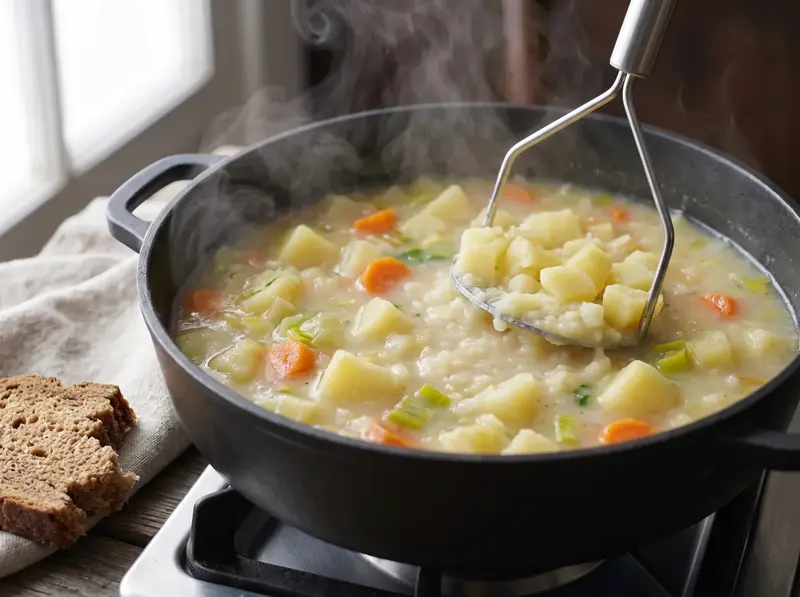
- Cut the sausages into rounds of about 1 cm. Take the pot off the heat, drop them in, cover and leave for five minutes, which is enough to heat them through. Boiling splits the casings and turns the filling rubbery. If you prefer them browned, give the slices two minutes per side in a dry pan first and add them to the bowls instead of the pot.
- Let the pot stand for ten minutes off the heat before serving. The potatoes keep releasing starch as they cool and the soup tightens noticeably in that time, so a version that looked thin will come out right. A ladleful should hold a spoon upright for about a second before it falls over. Taste again at the very end, it will take more salt than you expect, and serve with the reserved bacon, the chopped parsley and dark bread.
FAQ
Floury ones, what German shops label mehligkochend: Bintje, Adretta, King Edward, or a russet if you are shopping in the US. They hold around 16 to 18 percent starch and their cells separate as they cook, which is what thickens the pot without flour. Waxy potatoes such as Charlotte, Sieglinde or most red-skinned varieties keep their shape, so you end up with broth that has potato cubes floating in it, a decent soup but not this one. If waxy is all you have, simmer ten minutes longer and mash more of them; better yet keep them for German potato salad, where holding their shape is the whole point.
A fast blade. Potato starch granules sit inside cell walls, and an immersion blender or a food processor tears those walls open and pulls out long chains of amylose that bind water into something closer to wallpaper paste. It takes about two seconds of continuous blending, which is why the soup can be perfect one moment and ruined the next. A masher, a ricer or a food mill presses the cells apart instead of shredding them, so they stay intact. Once the soup has gone gluey you can thin it with hot broth to make it edible, but the slick texture does not come back.
It is the tied bundle of soup vegetables sold in every German supermarket: one carrot, a wedge of celery root, a leek and a sprig of parsley, sometimes with a parsley root. Outside Germany just buy the parts separately, roughly 150 g carrot, 100 g celery root and 150 g leek for this quantity. The one piece worth hunting down is the celery root, since it carries the savoury background of the soup. If you cannot find it, use two stalks of celery plus a small parsnip, and accept that the result is a little sweeter and thinner in flavour.
The classic choice is a cooked, lightly smoked sausage in a natural casing: Bockwurst, Wiener, Knackwurst or a good frankfurter. They are already cooked, so they only need warming in the covered pot off the heat. Bratwurst is raw and will grey out and leak fat if you drop it straight into the liquid, so if you want to use bratwurst, fry the links first, let them rest, then slice them into the bowls. In Thuringia the slices go into the pot; further north the sausage is often served whole alongside so it keeps its snap.
Freeze the base, not the finished soup. Stop after the potatoes are mashed, cool the pot quickly and freeze for up to three months; the cream would separate into grains on thawing and the sausage turns mealy. Thaw overnight in the fridge, reheat gently to about 80°C, then stir in the cream and add the sausage as in the recipe. For leftovers that already have cream in them, add 50 to 100 ml of broth per portion, warm them slowly and never let the pot boil, since boiled cream in a starchy soup is what makes it look curdled.
Rate this
Keep browsing
More dishes from the German archive — picked by overlap with what you're cooking now.


Join the conversation
Comments
No comments yet — be the first!