
German autumn cooking runs on two calendars at once. From September the wine villages of the south-west sell Federweisser, the cloudy young wine that is still fermenting in the glass, and bake onion tart and Flammkuchen to go with it. From October the kitchen turns to pumpkin, potatoes and cabbage, and on 11 November, St Martin's Day, a roast goose comes out of the oven with braised red cabbage beside it.
The six recipes below follow that order. None of them is difficult, but each has one step where most home versions go wrong, and that step is what this piece is about.
Zwiebelkuchen: the onions go in cold
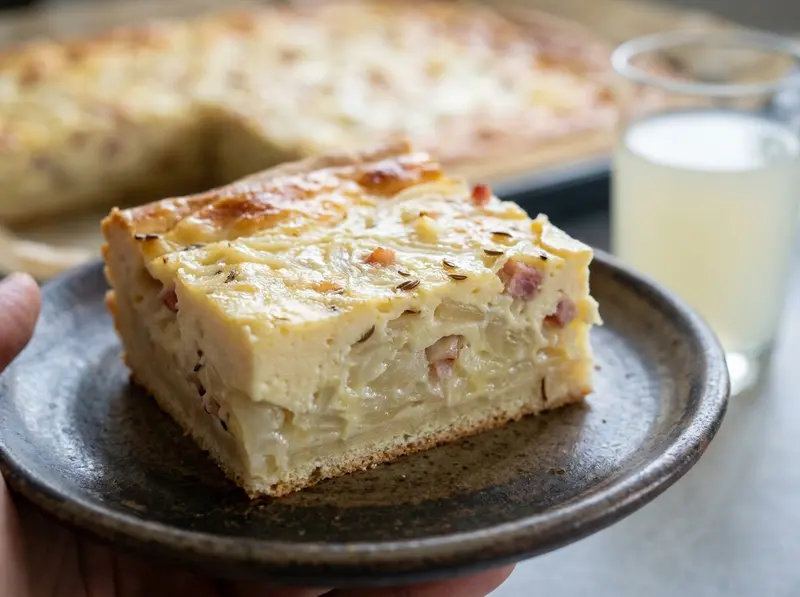
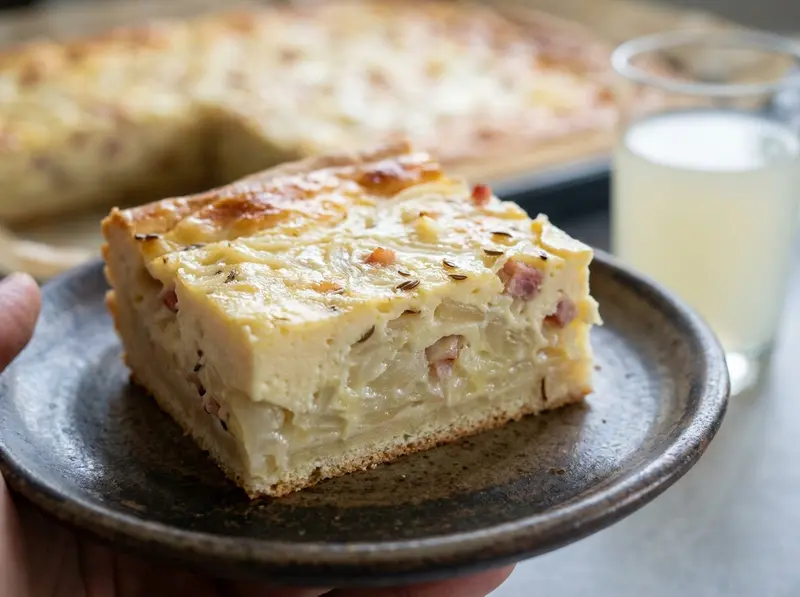
Zwiebelkuchen is a savoury onion tart from Swabia, the Palatinate, Baden and Franconia: a thin yeast dough in a sheet pan, well over a kilo of onions, bacon, sour cream, eggs and caraway. The wine festivals sell it by the square with a glass of Federweisser.
The usual failure is a grey, damp base under a perfectly good topping. Warm onions soften the butter in the raw dough and steam it from below. Sweat them without letting them colour, spread them on a tray until they are no warmer than your hand, pour off any liquid, and bake on the lowest rack at 200°C. A couple of spoonfuls of semolina scattered over the dough first soak up whatever still gets through. One label trap while you shop: Kümmel means caraway, not cumin.
Flammkuchen: thin, hot and slightly burnt
Flammkuchen, tarte flambée in French, comes from Alsace, and Baden and the Palatinate across the Rhine bake it at their own September festivals. It is a cracker-thin flatbread of flour, water and oil, spread with soured cream and scattered with raw onion rings and smoked bacon. There is no yeast, and that is the point: it should snap, not chew.
A home oven cannot copy the stone floor of a wood-fired one, so heat a heavy baking sheet at 250°C for twenty minutes and slide the Flammkuchen onto it on its paper. Ten to twelve minutes is enough. Spread the cream about as thick as butter on toast and slice the onion no thicker than 2 mm, or the middle steams instead of baking. The blackened tips of the onion rings carry half the flavour, so don't pull it out while it is still an even gold.
Kürbissuppe: leave the skin on
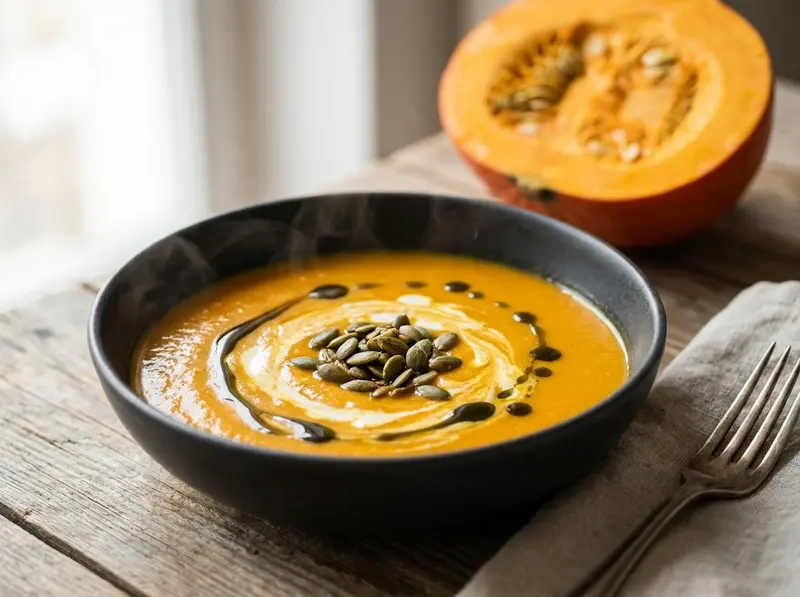
German pumpkin soup is made from Hokkaido squash, the small orange one, cooked with onion, ginger and a little cream from late September through November. The skin stays on. It softens completely in twenty minutes of simmering and brings colour and a chestnut note that peeled butternut does not have.
Two steps make the difference. Brown some of the cubes in butter before any liquid goes in, because boiled pumpkin on its own tastes flat and sweet. Then add broth only to just below the level of the pumpkin: the squash releases plenty of its own water, and a full litre at the start turns soup into orange broth. It is finished at the table with toasted seeds and a thin spiral of Styrian pumpkin seed oil, which goes on cold and never into the pot.
Kartoffelsuppe: the potatoes do the thickening
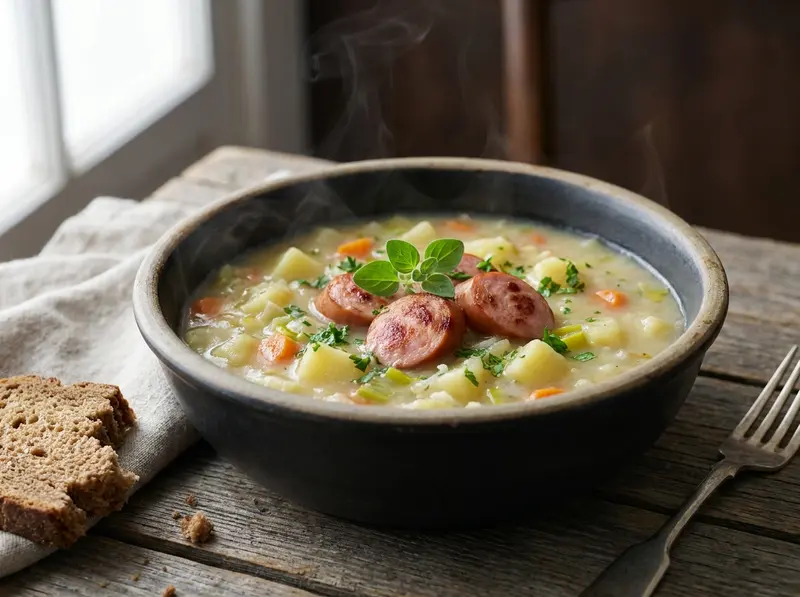
Kartoffelsuppe is the everyday potato soup of German kitchens: floury potatoes cooked with Suppengrün, the tied bundle of carrot, celery root, leek and parsley, seasoned with marjoram and finished with sliced Bockwurst or Wiener sausages. There is no flour in it and no roux.
Once the potatoes collapse under a spoon, press about a third of them against the side of the pot and stir. The starch you release is the thickener. An immersion blender left running a couple of seconds too long does the opposite and turns the whole pot to glue. The sausages go in off the heat for five minutes, since boiling splits the casings, and a teaspoon of vinegar at the end keeps the soup from tasting dusty.
Martinsgans: breast down for the first hour
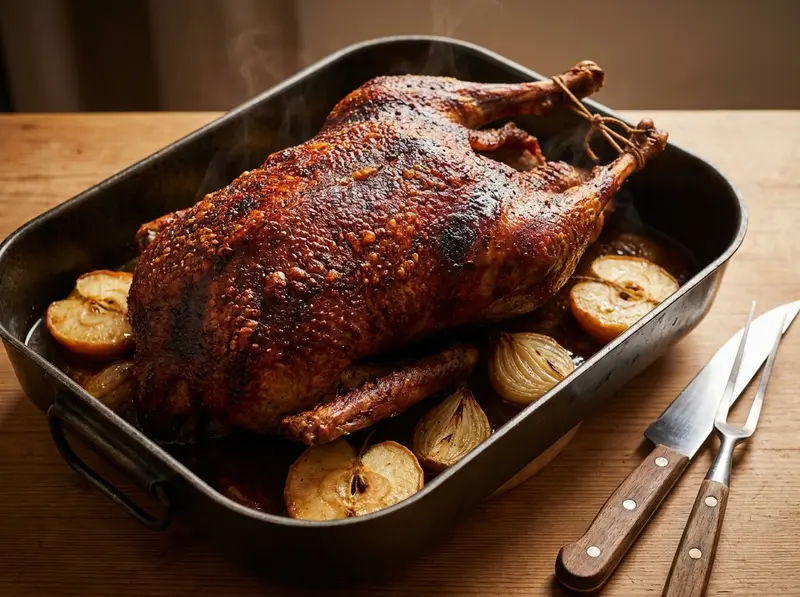
Martinsgans is the roast goose eaten around 11 November, the feast of St Martin. Legend has Martin hiding in a goose pen to avoid being made a bishop until the geese gave him away. The older reason is the farming calendar: Martinmas was when leases ended and dues were paid, often in poultry. The bird is stuffed with apples, onions and mugwort, a bitter herb German cooks have used with goose for centuries because it cuts the fat.
Goose fails in a predictable way: the breast dries out before the legs are tender. Roast it breast down for the first hour at 180°C so the fat on the back bastes the lean meat, then turn it and carry on at 160°C. Ladle off the fat as it collects, because left in the tray it smokes and burns the base for the gravy. The thigh needs 82 to 85°C, well above chicken, before a last 15 to 20 minutes at 220°C crisps the skin. Keep the fat in a jar. Potatoes roasted in it are reason enough to cook the bird.
Rotkohl: vinegar before heat
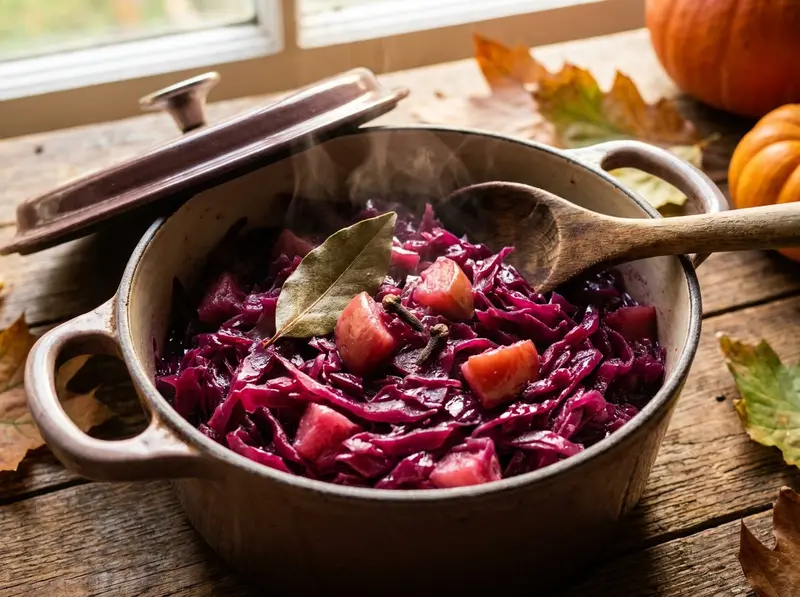
Rotkohl is red cabbage braised with apple, onion, vinegar, cloves and a few juniper berries, and from October it sits beside the goose and most other German roasts. In Bavaria the same dish is called Blaukraut, and the two names are a small chemistry lesson: red cabbage pigment behaves like a pH indicator, red with acid and blue-grey without it.
That is why the vinegar goes onto the raw shredded cabbage with the salt and sugar before the pot ever gets warm. Add it at the end and the colour never comes back. Braise it low for an hour with sharp apples such as Boskoop, then stir in redcurrant jelly off the heat. It tastes better the next day, which is handy: made on 10 November, it leaves the stove free for the goose.
→ Rotkohl
What else to cook this season
The same Rotkohl belongs next to beef rouladen, the Sunday roast of rolled beef with mustard, bacon and gherkin. And a pan of Käsespätzle under fried onions covers the cold evenings between the last wine festival and Martinmas.