
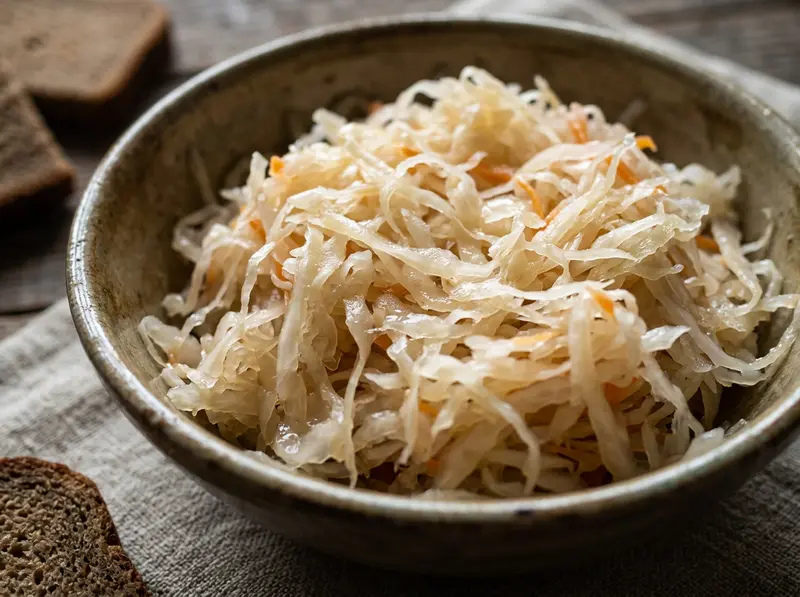
Russian Sauerkraut (Kvashenaya Kapusta)
Kvashenaya kapusta (квашеная капуста) is Russian sauerkraut: shredded white cabbage and grated carrot, salted dry and left to sour in their own juice, with no vinegar and no added water. In English it also goes by Russian sauerkraut or Russian fermented cabbage. This batch is 2.5 kg of shredded cabbage, 250 g of carrot and 65 g of salt, which comes to about 2.4 % of the vegetables by weight. Count on about 1 hour of work, then 5 days at room temperature and 2 days in the fridge. Many Russian kitchen recipes end the warm stage after 3 days; this one runs it for 5, so the cabbage has more time to turn sour before it goes into the cold. The USDA procedure for sauerkraut ferments for 3 to 4 weeks; this is the shorter Russian method, so the cabbage is kept in the fridge and never in a cupboard. It has no sugar and no spices in it.
What is kvashenaya kapusta?
Kvashenaya kapusta, квашеная капуста in Russian, is cabbage preserved by fermentation. The shreds are rubbed with salt, the salt pulls out their juice, and the cabbage sours in that natural brine as lactic acid builds up. Rospotrebnadzor, the Russian consumer-health agency, draws the line this way: in marinating the acid is added from outside as vinegar, while in kvashenie, fermenting, the acid is made by the fermentation and acts as the preservative. So a jar of cabbage in vinegar is a different thing, however similar it looks.
The standard Russian version is shredded white cabbage with carrot; the Russian state standard for the shop product even uses "shredded fermented cabbage with carrot" as its example of a product name. Carrot is kept to about 10 % of the cabbage. Cranberries are the best-known addition, at about 3.5 % of the cabbage, which would be about 90 g for this batch; lingonberries, apples, caraway and beetroot are the other additions the standard lists. This recipe is the plain kind, cabbage, carrot and salt.
Kvashenaya kapusta vs sauerkraut and kimchi
The chemistry is the same as in sauerkraut; the habits around it differ. The USDA procedure for sauerkraut uses cabbage and salt only, with no carrot, and ferments it for 3 to 4 weeks at 21–24 °C. German sauerkraut is made with about 2 % salt, takes 2 to 6 weeks depending on the temperature, and is usually braised with bay leaf, juniper and caraway before serving.
Russian kitchen recipes keep the cabbage warm for a few days, often 3, and then move it to the cold, where it is eaten raw. This recipe sits between the two traditions on purpose: it uses the Russian method and the carrot, takes the salt from the 2.25–2.5 % given by Clemson University's extension service, and runs the warm stage for 5 days so the brine has time to turn properly sour.
Kimchi is the Korean relative, and the difference is easy to taste: kimchi is spicy, while Russian fermented cabbage has no heat at all.
How to serve kvashenaya kapusta
Olga Syutkina, a historian of Russian cooking, serves it with a pinch of sugar over the top, a little finely sliced onion and a splash of unrefined sunflower oil, with boiled potatoes next to it. Other Russian recipes swap the sliced onion for green onion.
It is also a cooking ingredient. It is the base of sauerkraut shchi, it goes into Russian vinegret salad, and the same kind of fermented cabbage is stewed with meat in Polish bigos.
Ingredients
- 2.5 kgwhite cabbage
- 250 gcarrots
- 65 gsalt
Method
- Get the equipment clean. Wash your hands, the board, the knife and a large mixing bowl of at least 5 litres. Wash a 5-litre enamelled pot that has no chips, a flat plate that fits inside it and a 0.5-litre glass jar with a lid, then scald all three with boiling water. A glass, ceramic or food-grade plastic container of the same size works too, but not aluminium, copper, brass, galvanised steel or iron, because the acid and the salt react with those metals.
- Shred and weigh. You need about 3 kg of white cabbage, 1 large or 2 medium heads, to end up with 2.5 kg of shreds. Pull off the outer green and damaged leaves, rinse the heads under cold running water, let them drain, cut them into quarters and cut out the cores. Slice the quarters across the leaf into shreds 2 to 3 mm wide and weigh out 2.5 kg of white cabbage. Peel the carrots, grate them on the coarse side of a grater and weigh out 250 g. Weigh 65 g of coarse salt that is not iodised. The weighing matters: the salt has to stay at about 24 g for every 1 kg of cabbage and carrot together, so if your shreds weigh more or less, change the salt to match.
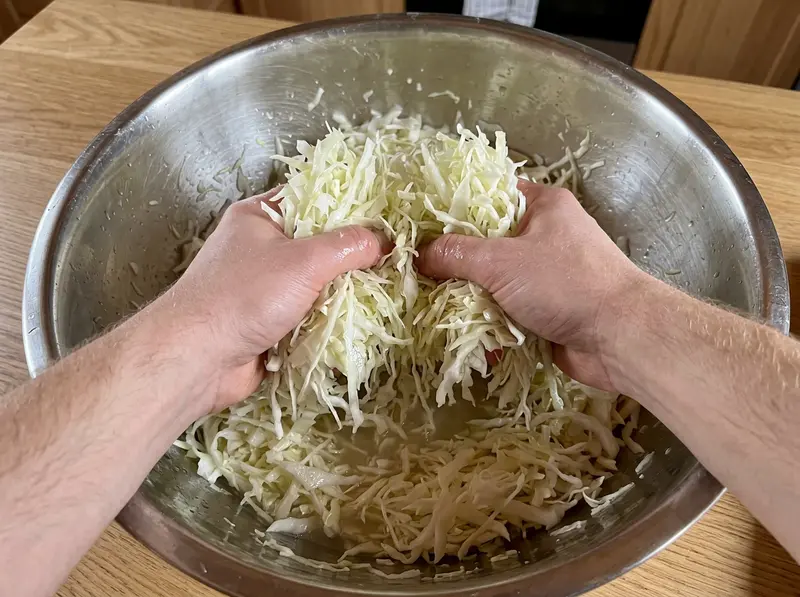
- Salt and knead the cabbage in two halves, because 2.5 kg of loose shreds is too much to work in one bowl. Put half of the cabbage (1.25 kg) into the mixing bowl, scatter half of the salt (about 32 g) over it, and squeeze and rub it hard with your hands for 3 to 5 minutes. The salt draws out the juice that will become the brine. Stop when the shreds are wet, glossy and limp, have sunk to about half their volume, and juice gathers at the bottom when you tilt the bowl. Mix in half of the carrots (125 g) with a light hand.
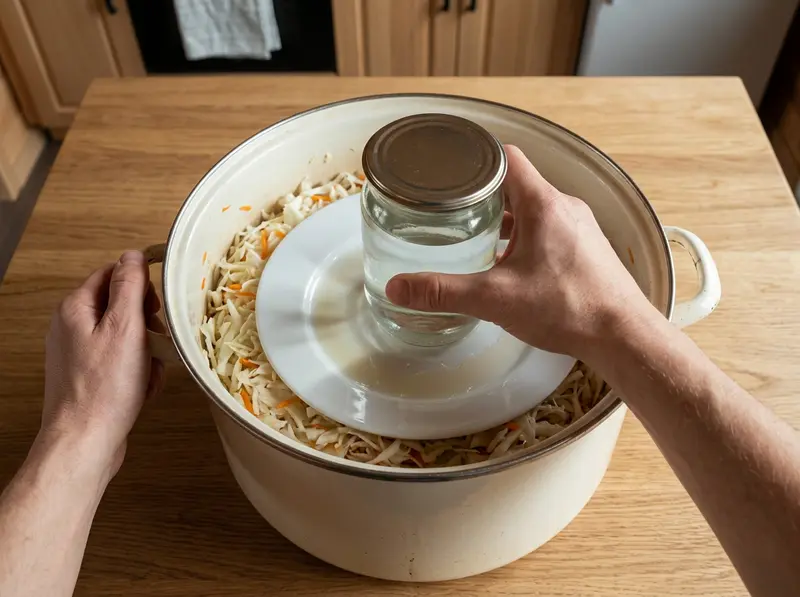
- Pack the pot. Tip the first half into the pot with all of its juice and press it down hard with your fist or a potato masher. Salt and knead the second half the same way with the rest of the salt and the rest of the carrots, add it to the pot and press again. Level the top, lay the plate on the cabbage, fill the 0.5-litre jar with water, close it and stand it on the plate as a weight. Cover the pot with a clean towel and not with a lid: the towel keeps insects and mould out and lets the gas escape. Set the pot on a tray in case the juice rises over the rim. Check it after a few hours. The juice should have risen over the shreds and reached the plate, because cabbage left above the brine goes mouldy quickly. If it has not, add a second jar of water as extra weight. If the juice still does not cover the cabbage after that, top it up with boiled and cooled brine made with 1½ tablespoons of salt per 0.95 litre (1 US quart) of water, never with plain water.
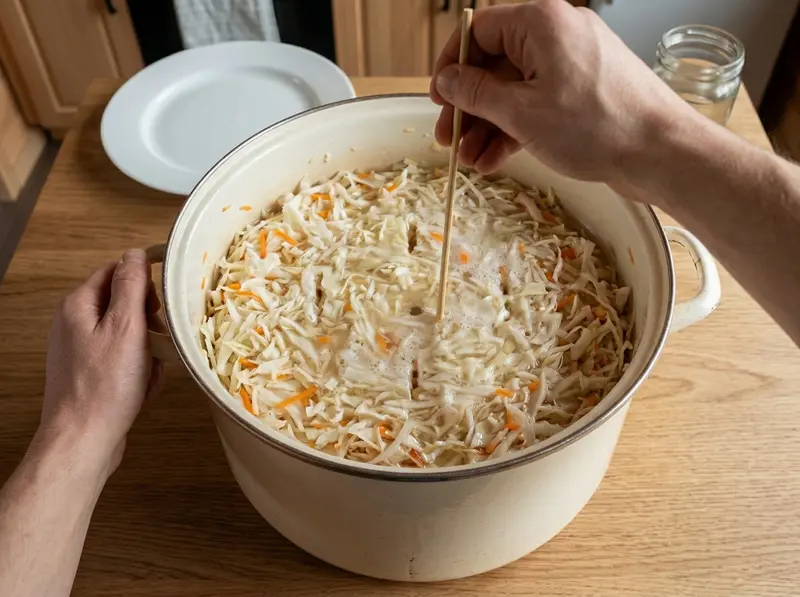
- Leave the pot at 18–22 °C for 5 days, counting the day after you packed it as day 1. By day 2 you should see bubbles rising, foam on top and a cloudy brine, and smell a clean sourness; that is normal fermentation. From day 2 to day 5, once a day, lift off the jar and the plate and push a clean wooden skewer or chopstick down to the bottom of the pot in 5 or 6 places to let the gas out. Skim off the foam with a clean spoon, because the yeasts in surface scum feed on the acid the cabbage needs. Rinse the plate with hot water, then put the plate and the jar back and cover the pot with the towel again. Keep the pot away from radiators and direct sun: above 24 °C the cabbage turns soft, and below about 15 °C it may not ferment at all.
- On day 5, decide whether it is done. It is ready when no new foam forms, the bubbling has stopped, the brine is turning from cloudy to clearer, and the cabbage is white to light straw-yellow, still crisp, and tastes sour and salty. If it still foams or bubbles, or the room has been at the cool end, near 18 °C, give it up to day 7, piercing and skimming once a day as before. If you have pH test strips, dip one into the brine before you move the cabbage to the cold: it should read 4.6 or lower. If it reads higher, leave the pot in the warm and test again every 1 to 2 days. Throw the whole batch away without tasting it if the cabbage is soft and slimy, smells rotten, or has mould growing on it or in it. Foam and a thin scum on the brine are the only things you skim off and carry on.
- Move it to the cold. Wash three 1-litre glass jars and their lids and scald them with boiling water; one 3-litre jar does the same job. Pack the cabbage into the jars, pressing it down, and pour in all of the brine so the cabbage is covered. Close the lids and put the jars in the fridge at 0–4 °C. An enamelled pot is fine for the days of fermenting but not for long keeping. Leave the cabbage in the fridge for 2 days before you eat it.

- Serve it cold, straight from the jar. Take it out with a clean fork, press what is left back under the brine and keep the jar closed in the fridge. It is at its best within 1 month and keeps for up to 2 months, as long as it stays covered by brine and still smells clean and sour. Do not store it at room temperature.
FAQ
Too little salt and too much heat are the usual reasons. A brine that is too weak comes first in the list of causes the US National Center for Home Food Preservation gives for soft, slippery fermented pickles, which is why this recipe weighs 65 g of salt for 2.75 kg of vegetables and does not measure it by the spoon. Above 24 °C cabbage softens, so keep the pot at 18–22 °C and away from radiators. Use firm heads and make sure the shreds stay under the brine the whole time. If the cabbage is already slimy or smells rotten, do not try to rescue it and do not taste it: throw it away.
Yes, both are normal. By day 2 the brine turns cloudy, bubbles rise and foam collects on top, and the smell is cleanly sour. The gas has to get out of the packed cabbage, so from day 2 to day 5 you push a clean wooden skewer down to the bottom of the pot in 5 or 6 places once a day; Russian cooks also say cabbage that is not pierced turns bitter. Skim the foam off each time, because the yeasts in surface scum feed on the acid. Toward the end the foam stops forming and the brine goes from cloudy to clearer, and that is your sign that the warm stage is over.
Keep it in closed glass jars in the fridge at 0–4 °C, with the cabbage pressed under its brine. It tastes best within 1 month and keeps for up to 2 months. At room temperature it over-sours within 2 to 3 days, so a cupboard or a warm balcony is the wrong place for it. Always take it out with a clean fork. Throw the cabbage away if the cabbage turns soft and slimy, smells rotten or grows mould.
Do not cut the salt: it should stay at about 24 g for every 1 kg of cabbage and carrot, which is inside the 2.25–2.5 % that Clemson University's extension service names for sauerkraut. Sugar is optional in Russian recipes, where a little is sometimes added to speed up the start; this recipe leaves it out, and the food-safety recipes do not use it. If the juice has not covered the cabbage after a few hours, add more weight first. If that does not help, the USDA method is to top it up with boiled and cooled brine made from 1½ tablespoons of salt per 0.95 litre (1 US quart) of water, never with plain water. Vinegar has no place in it: the sourness comes from the fermentation alone.
Both are cabbage soured by salt and lactic fermentation, with no vinegar. The Russian kind is made with grated carrot, about 10 % of the cabbage, spends only 5 days in the warm here and is then eaten cold and raw, like a salad. German sauerkraut ferments for 2 to 6 weeks and is usually braised before it is served. Russian cooks also put it into soup and salads: it is the base of sauerkraut shchi and goes into vinegret.
Rate this
Recipes by email
One letter a week: a recipe picked for your taste, plus whatever is new on the site. Unsubscribe in one click.
Welcome gift: Sergei's cookbook (e-book).
By subscribing you agree to the privacy policy.
Tell us what you like to cook (30 seconds) →Keep browsing
More dishes from the Russian archive — picked by overlap with what you're cooking now.



Join the conversation
Comments
No comments yet — be the first!